Recent Discoveries Spark Social Media Panic, But Experts Say Evidence Points Elsewhere
The discovery of three bodies in Houston's bayou system during the final week of December 2025 has reignited viral speculation about a Texas serial killer prowling the city's waterways. Social media platforms erupted with theories after authorities recovered the bodies within days of each other, bringing the year's total to 34—nearly matching 2024's record of 35 Houston bayou bodies.
On December 22, Houston Police responded to two separate bayou locations within minutes of each other. The first body was found in Buffalo Bayou near Crawford and Ruiz Streets around 9:30 a.m., followed by a second discovery at Brays Bayou near Old Spanish Trail and MLK Boulevard just five minutes later. Two days later, on Christmas Eve, a third body was recovered from Buffalo Bayou at Memorial Drive near Montrose Boulevard.
The clustering of these deaths has fueled online fears of a serial killer operating in Houston, with comparisons to similar conspiracy theories that have emerged in Austin. But Houston officials, law enforcement, and criminal justice experts are united in their message: there is no evidence linking these deaths to a single perpetrator.
This investigation examines what's really happening in Houston's bayous—separating viral speculation from verified facts, exploring expert analysis, and providing context for why drownings in urban waterways are far more common than the public realizes.
The Timeline: A Pattern of Discoveries
The Harris County Institute of Forensic Sciences has documented 34 bodies recovered from local bayous in 2025, closely tracking last year's total of 35. While December's discoveries sparked the latest wave of concern, they followed a pattern that has troubled Houston residents throughout the year.
The most alarming cluster occurred in September, when five bodies were found in Houston bayous within a six-day period between September 15 and September 20. That series included the death of 20-year-old University of Houston student Jade McKissic, whose body was recovered from Brays Bayou on September 15. Preliminary investigations indicated no signs of trauma or foul play in her case.
In the most recent December incidents, one of the bodies discovered was in such an advanced state of decomposition that investigators could not immediately determine the person's age or other identifying details at the scene. The condition of the remains highlights one of the key challenges facing investigators: bodies recovered from water often deteriorate significantly, making cause of death determinations difficult and time-consuming.
According to local news reports, 12 bodies have been recovered from Buffalo Bayou alone in 2025, marking a record high for that waterway in the last decade. The repeated discoveries in familiar locations have contributed to public perception that something sinister is occurring—a perception that officials say isn't supported by evidence.
The Data: Historical Context Matters
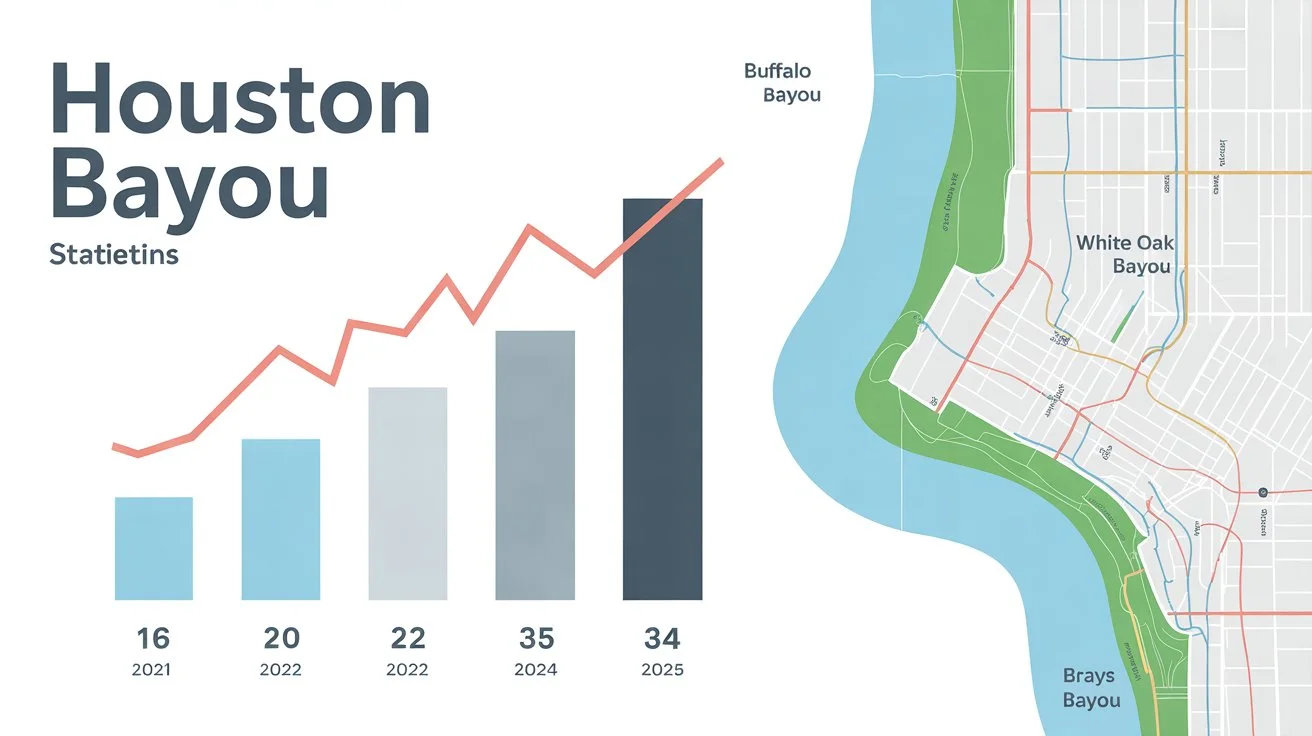
To understand whether 2025 represents an anomaly or continues a troubling trend, examining historical data is essential. Since 2017, approximately 190 bodies have been found in Harris County bayous, with the numbers showing a general upward trajectory in recent years.
The year-by-year breakdown reveals:
- 2025: 34 bodies (as of late December)
- 2024: 35 bodies (highest on record)
- 2023: 22 bodies
- 2022: 20 bodies
- 2021: 16 bodies
The data shows that bayou deaths have nearly tripled since 12 were reported in 2019, a statistic that alarms residents and fuels speculation. Most victims are men in their 30s, 40s, and 50s, and Buffalo Bayou, White Oak Bayou, and Brays Bayou account for the majority of discoveries.
The causes of death documented by the Harris County Medical Examiner's Office paint a complex picture. Forensic investigators have documented causes ranging from drug-related drownings to blunt-force trauma, with numerous cases remaining classified as "undetermined". In fact, nearly 40 percent of the bodies have undetermined causes of death, a classification that doesn't indicate investigative failure but rather reflects the limitations of evidence when bodies have spent time in water.
Among the identified causes: accidental drownings combined with drug toxicity (particularly phencyclidine and alcohol), cardiovascular events, blunt force injuries, one confirmed homicide, and one suicide. The variety of causes argues against a single perpetrator, experts say.
Social Media Panic: The Viral Serial Killer Theory
The rise of true crime podcasts and social media sleuths has created a perfect storm for speculation. When the September cluster of bodies was discovered, TikTok videos and Twitter threads exploded with theories about a "Houston serial killer" or comparisons to Austin's debunked "Rainey Street Ripper."
"The math isn't mathing, I think there's a serial killer," said Juan Sandoval, a visitor to Houston. "I get Nevada's 'for you' page now, and even in Nevada, they're talking about Buffalo Bayou, so it's that bad, it's reaching another state, across state lines."
His friend Erick Cortez, who lives in Houston, expressed similar concerns: "There must be someone out there, no? Because it's ridiculous that so many people are dying in the bayou, I think it's unfortunate that they haven't found the person."
These sentiments reflect a broader phenomenon identified by criminologists: our cultural fascination with serial killers has primed us to see patterns where none may exist. "The serial killer really dominates our entertainment," said Dr. Krista Gehring, criminology professor at the University of Houston-Downtown. "When we hear that there are multiple deaths, our brain automatically goes 'It must be a serial killer,' because that's the script that we know the best."
Gehring explained that we crave simple narratives: "It's sort of comforting to have a villain to place all of these deaths on. Because the alternative is having to reconcile with the fact of what these deaths could actually be. We don't want to have the notion that we don't take care of people in our society and that, unfortunately, they may perish because of it in these ways."
The psychological appeal of a serial killer theory is powerful—it provides a concrete explanation, a clear villain, and the promise that capturing one person could end the deaths. The messier reality of accidental drownings, substance abuse, mental health crises, and homelessness doesn't offer such satisfying resolution.
Official Response: What Authorities Are Saying
City and law enforcement officials have worked to counter misinformation while acknowledging the legitimate concerns of residents. Their message has been consistent: no evidence connects these deaths.
Houston Police Department's Position
At a September press conference following the cluster of five deaths, Houston Police Chief J. Noe Diaz Jr. stated firmly: "Rumors stir fear and anxiety in our communities." He emphasized that investigators have found no evidence linking the cases and that each death has different circumstances.
Each case is investigated separately, with causes of death determined by Medical Examiner autopsies. When Houston Public Media visited the scene of one December discovery, HPD Sgt. Michael Cass noted the body was so significantly decomposed that investigators could not determine the person's age or "much about it at all, at this point".
Mayor John Whitmire's Stance
Mayor John Whitmire has been direct in his dismissal of serial killer theories. "We do not have any evidence that there is a serial killer loose in Houston, Texas," Whitmire stated at a September press conference. "Let me say again that there is no evidence that there is a serial killer loose in the streets of Houston. If there was, you would hear it from me first."
Whitmire expressed frustration with social media speculation: "Enough is enough of misinformation, wild speculation by either social media, elected officials, candidates, the media. It's very frustrating to me to be at home, watch the news or social media and see people spread what I know to be false."
The mayor has attributed many deaths to Houston's challenging social issues, noting: "Houston has 2,500 miles of bayous and waterways". He has pointed to factors including homelessness, substance abuse, mental health crises, and accidental drownings as explanations for the deaths.
Expert Analysis
Criminal justice experts support official conclusions with scientific reasoning. Dr. Krista Gehring states emphatically: "Absolutely not. Unless you have stab wounds, gunshots, strangulation marks—clear signs of homicide—it's not a serial killer. People slip, people fall, people drown. That's reality."
Gehring explained how crime television shapes public perception: "Because a lot of times people think, 'Oh they're in the bayou, they are dumping the body to get rid of evidence,' because that's what we see in those shows, that the water will wash away the evidence. People could have just had an accident, people could've done this to themselves, people could've been intoxicated."
Retired Houston Police Captain Greg Fremin offered perspective on the city's safety: "I tell the citizens of Houston, we have a relatively safe city for the most part, but it's just like any other big city, there is crime, you have to be vigilant, have situational awareness of what's going on but this is not anything to be concerned about."
Conflicting Perspectives: Families Seek Answers
While officials and experts dismiss serial killer theories, some families remain unconvinced by official explanations. Lauren Freeman, whose cousin Kenneth Cutting Jr. was discovered in Buffalo Bayou last year, said: "I don't think anybody ever prepares you to lose somebody that's that close to you."
For families dealing with "undetermined" rulings on causes of death, the lack of clear answers can be agonizing. Dr. Elizabeth Gilmore, a forensic criminologist at the University of Houston, explained that an undetermined ruling doesn't mean investigators failed: "What that means is that the pathologist has done as thorough as an examination as they possibly can. And what they have decided is that they cannot attribute what the manner of death would be… there's just not enough information for the doctor to say this is what happened."
The challenge is that when bodies spend time in water, especially in Houston's warm climate, critical evidence deteriorates. Soft tissue decomposes, potential signs of trauma can be obscured, and determining time of death becomes difficult. This scientific reality doesn't ease the pain for families seeking closure.
Some community members point to demographic patterns—mostly men between 30-50 years old—and repeated locations as evidence of suspicious activity. However, these patterns also align with known risk factors for accidental drowning: males, particularly those in middle age, are more likely to engage in risky behavior near water and are overrepresented in drowning statistics nationwide.
The Science: Why Bodies End Up in Urban Waterways
Understanding the Houston bayou deaths requires examining both the city's unique geography and the science of drowning and decomposition.
Houston's extensive bayou network spans 2,500 miles of waterways winding through the nation's fourth-largest city. These urban waterways attract vulnerable populations—those experiencing homelessness, individuals in mental health crisis, and people seeking isolated locations. The bayous' accessibility makes them both a resource and a risk.
When someone enters water, bodies typically sink initially. As decomposition progresses, gases build up, eventually causing the body to rise and surface—sometimes long after death. Heat accelerates this process significantly. In Houston's consistently warm climate, decomposition happens faster than in cooler regions, destroying soft tissue and erasing signs of trauma that might indicate how death occurred.
Water currents can move bodies considerable distances from where someone entered the water, complicating efforts to reconstruct events. The combination of decomposition and water damage often means investigators must rely on dental records, fingerprints (if skin remains intact), or DNA testing—all time-consuming processes.
Many documented cases involve alcohol or drug use. Intoxication near water is a deadly combination: impaired judgment, loss of coordination, and decreased ability to respond to danger significantly increase drowning risk. The bayous' edges can be steep and slippery, making accidental falls common, especially after rainfall.
Lessons from Austin: The Debunked "Rainey Street Ripper"
Houston's situation closely parallels conspiracy theories that gripped Austin in recent years, where bodies recovered from Lady Bird Lake sparked similar serial killer speculation. The comparison is instructive because Austin's case has been thoroughly investigated and debunked by academic research.
Texas State University's Center for Geospatial Intelligence and Investigation, led by Dr. Kim Rossmo, conducted an independent analysis of 189 drowning cases around Lady Bird Lake from 2004 to 2025. The study found no evidence of a serial murderer and no indirect warning signs of a serial predator.
The research concluded that drowning frequency remained relatively stable over years, varying between two and five drownings annually. The patterns were consistent with statewide and international data, with 78% of victims being males predominantly between ages 22 and 44. Similar patterns have been documented in the Great Lakes, Australia, Canada, and the United Kingdom—locations where alcohol consumption and water access increase accidental drowning risk.
The Austin study found that proximity of bars to the shoreline and population growth in entertainment districts contributed significantly to the deaths. After Austin invested nearly $1 million in safety improvements along trails—including better lighting, fencing, and increased patrols—drowning incidents in targeted areas decreased.
The lesson? Drownings near urban waterways are tragically common. Dr. Gehring noted that "serial homicide is very rare" in general, and serial killings have declined since the 1970s-2000 period sometimes called the "golden age of serial murders". The statistical reality: accidental drownings vastly outnumber serial killings.
What Residents Should Know About Safety
While Houston doesn't face a serial killer threat, the city does have legitimate safety concerns around its bayou system. Residents and visitors should exercise reasonable caution without succumbing to unfounded panic.
Near Waterways:
- Be aware of surroundings, especially at night or in isolated areas
- Avoid bayou edges after consuming alcohol
- Watch for slippery conditions, particularly after rain
- Keep a safe distance from water's edge
- Never swim in bayous due to currents and water quality
For Vulnerable Populations: Houston has resources available for those experiencing homelessness, substance abuse issues, or mental health crises:
- The Houston Police Department's non-emergency line for welfare checks
- Mental health crisis hotlines providing 24/7 support
- Substance abuse treatment programs through Harris County services
- Homeless outreach programs connecting people with shelters and services
When to Contact Authorities: Report concerns about someone in distress near waterways immediately. If you observe suspicious activity or discover a body, call 911 rather than approaching the scene.
The key is maintaining perspective. Houston remains relatively safe for a major metropolitan area. Situational awareness near water is prudent—fear-driven panic is not.
The Bigger Picture: Addressing Root Causes
The conversation about Houston bayou bodies often misses the larger context: many victims are society's most vulnerable members. The deaths reflect challenges including homelessness, addiction, and mental health crises—complex, intractable problems that don't lend themselves to simple solutions or satisfying narratives.
Chasing an imaginary serial killer is easier than confronting these systemic failures. When someone experiencing homelessness drowns in a bayou, it raises uncomfortable questions about social safety nets, access to healthcare, substance abuse treatment, and how communities care for their most vulnerable members.
Some deaths involve people who intentionally entered the water. Others involve accidents by intoxicated individuals. Still others remain mysteries due to decomposition and water damage. Each represents a life lost and a family grieving—realities that get lost in viral speculation and conspiracy theories.
Improved lighting, fencing, and increased patrols near high-risk areas could prevent some deaths, as Austin's experience demonstrates. But preventing all drownings in a city with 2,500 miles of waterways is impossible. The focus should be on evidence-based prevention rather than chasing phantoms.
Conclusion: Facts Over Fear
The evidence is clear: there is no serial killer operating in Houston's bayous. Police Chief Noe Diaz has stated there is no evidence linking the cases, and each death is investigated separately with different circumstances and causes.
The 34 bodies recovered in 2025 represent a tragic toll, but one consistent with patterns seen in previous years and explainable by factors including accidental drowning, substance abuse, mental health crises, and the challenges faced by vulnerable populations near urban waterways. The increase from previous years correlates with Houston's population growth and the extensive bayou network that characterizes the city.
True crime entertainment has shaped how we interpret clusters of deaths, priming us to see serial killers where accidental drownings are the reality. As Dr. Gehring explained, serial killings have declined significantly since their peak decades ago, while drownings remain far more common than the public realizes.
For Houston residents, the appropriate response involves supporting evidence-based safety measures, expanding resources for vulnerable populations, and maintaining reasonable caution near waterways—not spreading unfounded theories that stir fear without evidence.
The Harris County Medical Examiner's office continues investigating each death, working to provide answers for grieving families. Some cases will remain classified as "undetermined" due to the nature of water recoveries. That ambiguity is frustrating but doesn't indicate cover-up or serial killings.
Houston faces real challenges around homelessness, addiction, and public safety. Addressing these complex issues requires community investment, expanded resources, and sustained attention—not viral speculation about imaginary killers. The truth may be less sensational than a serial killer theory, but it's the truth nonetheless.
For updates on this developing story and other Houston news, continue following Findsfy's coverage.
By The Numbers
- 34 bodies found in Houston bayous in 2025
- 200+ total bodies recovered from bayous since 2017
- 2,500 miles of bayou waterways in Houston
- 0 evidence of serial killer, according to authorities
- 40% of cases with undetermined cause of death
- 12 bodies found in Buffalo Bayou alone in 2025
Resources for Houston Residents
Houston Police Department (non-emergency): 713-884-3131
Mental Health Crisis Hotline: 713-970-7000
Substance Abuse Resources: Harris County Behavioral Health Services
Homeless Outreach: Coalition for the Homeless of Houston/Harris County
Have information about Houston bayou deaths? Contact Findsfy's investigative team. All tips are confidential.
Frequently Asked Questions (FAQ)
1. Is there actually a serial killer in Houston?
No. Houston Police, the mayor, and criminal justice experts confirm there is no evidence linking the bayou deaths to a single perpetrator. Each case has different circumstances and causes.
2. How many bodies have been found in Houston bayous in 2025?
Thirty-four bodies were recovered from Harris County bayous in 2025 as of late December, nearly matching 2024's record total of 35 bodies discovered throughout the entire year.
3. What causes these deaths in Houston's bayous?
Causes include accidental drownings often involving drugs or alcohol, mental health crises, homelessness-related incidents, blunt force trauma, and cardiovascular events. About 40% remain classified as undetermined due to decomposition.
4. Why do social media users believe there's a serial killer?
True crime entertainment culture primes people to see patterns where none exist. The clustering of discoveries and viral speculation create compelling narratives, though evidence doesn't support serial killer theories.
5. How can Houston residents stay safe near bayous?
Exercise situational awareness near waterways, especially at night. Avoid bayou edges when intoxicated, watch for slippery conditions after rain, and never swim in bayous due to dangerous currents and water quality.