
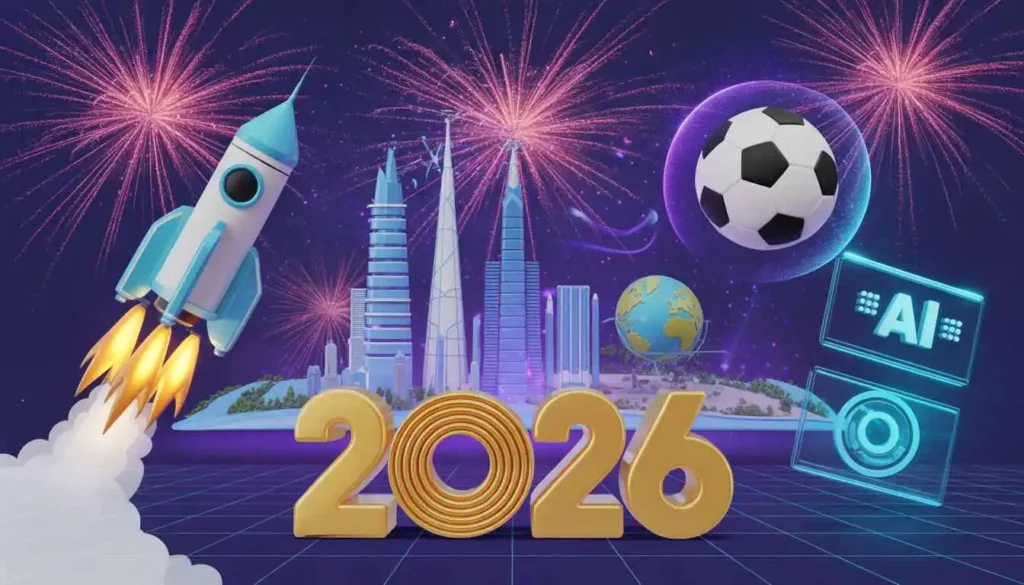
Happy New Year 2026! As we step into a new chapter filled with promise and possibility, we at Findsfy are thrilled to welcome you to the year ahead. Behind us lies 2025—a year that challenged and changed us in equal measure, from technological breakthroughs to global transformations. From the devastating Los Angeles wildfires to Donald Trump's return to the presidency, from remarkable AI advancements to historic space missions, the year tested our resilience while showcasing humanity's remarkable capacity for innovation and adaptation.
Now, as the calendar turns to 2026, we find ourselves at a fascinating crossroads. This year promises to be extraordinary, with groundbreaking space missions, transformative AI developments, major sporting events, and crucial conversations about our planet's future. Whether you're making personal resolutions or simply curious about what lies ahead, this comprehensive guide will walk you through everything you need to know about 2026. From confirmed events to expert predictions, from technology trends to sustainability shifts, we've gathered the insights that will help you navigate the year ahead with confidence and excitement.
The Year We Left Behind: 2025's Defining Moments
Before looking forward, let's briefly reflect on what shaped 2025. Understanding where we've been helps illuminate where we're going.
Presidential transitions and political shifts dominated headlines as Donald Trump was inaugurated for his second term on January 20, becoming only the second president to serve non-consecutive terms. His administration's sweeping policy changes on immigration, trade tariffs, and government restructuring sparked nationwide protests and reshaped America's domestic and international landscape.
Climate disasters struck with unprecedented force. The Los Angeles wildfires in January killed at least 28 people and destroyed over 16,000 structures, becoming one of the costliest natural disasters in U.S. history. Extreme weather events throughout the year—from violent tornadoes to severe flooding—reminded us that climate change isn't a future threat but a present reality.
Artificial intelligence reached new heights. OpenAI released GPT-5, Google launched Gemini 3, and the race for AI dominance intensified globally. China's DeepSeek R1 prompted the U.S. to announce a $500 billion "Stargate" project, signaling that AI competition would define geopolitical relationships for years to come.
Space exploration made historic strides. Firefly Aerospace achieved the first successful commercial lunar landing, touching down on the Moon's surface. NASA continued preparations for the Artemis II mission, bringing humanity closer to returning to the Moon after more than 50 years.
A fragile peace emerged in Gaza. After years of devastating conflict, a ceasefire was reached between Israel and Hamas in October, with the release of the last 20 hostages and hundreds of Palestinian prisoners. While the truce remained precarious, it offered hope for stability.
Gen Z activism reshaped governments. Youth-led protests in Nepal, Madagascar, and other nations demonstrated the growing political power of younger generations demanding change on social media restrictions, climate action, and democratic reforms.
These moments taught us valuable lessons about resilience, adaptation, and the interconnected nature of our world. They set the stage for what promises to be an equally consequential year in 2026.
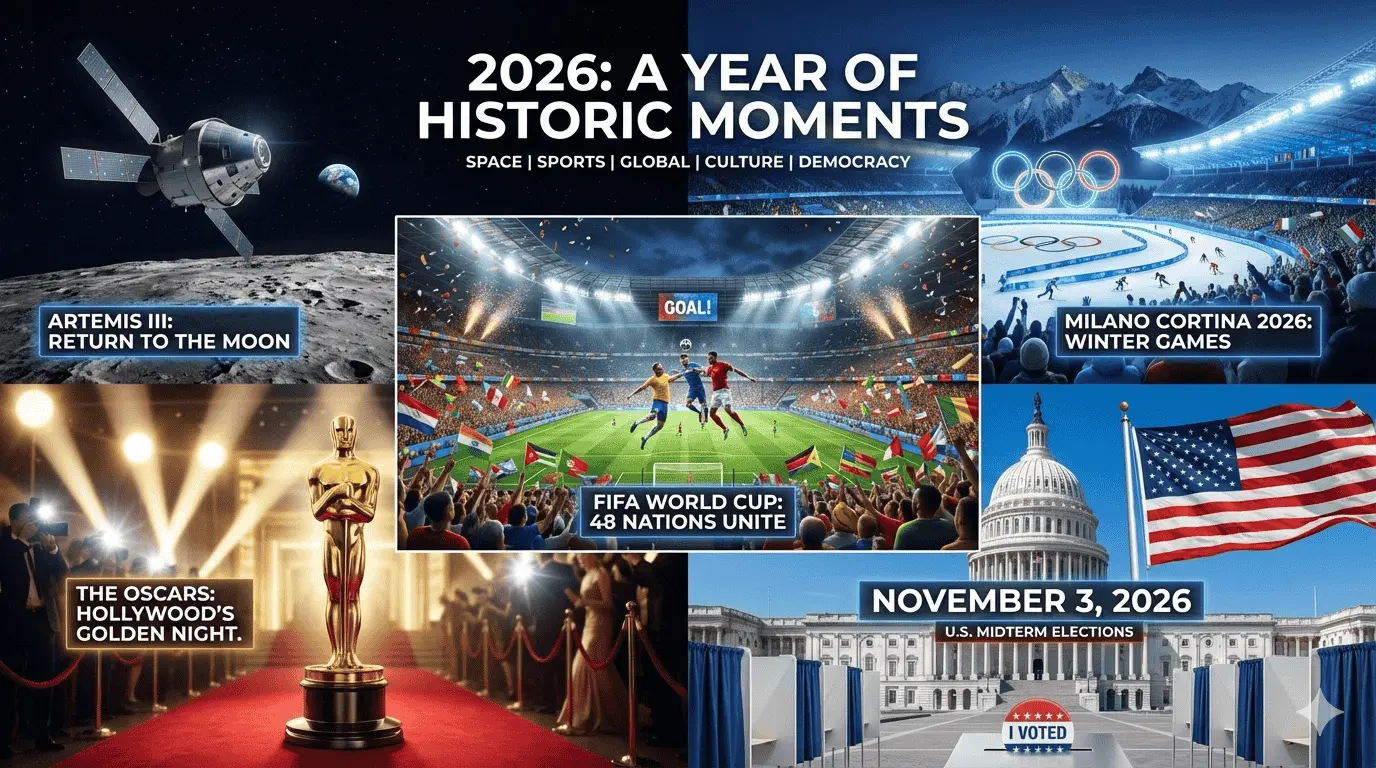
Major Events Already on the 2026 Calendar
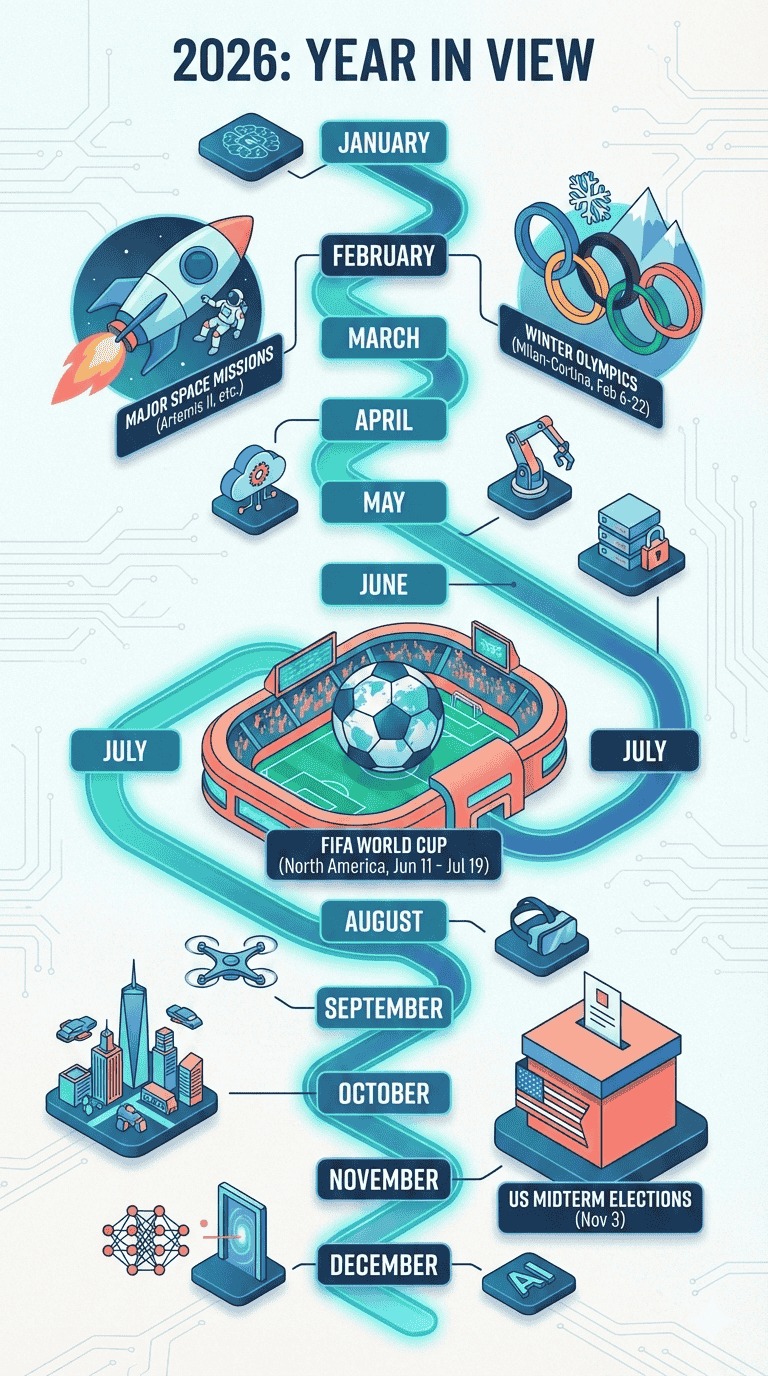
The year ahead isn't just speculation—many significant events are already scheduled. Here's your month-by-month guide to what's confirmed for 2026.
Space Exploration Takes Center Stage
February-April: Artemis II Moon Mission — The most anticipated space event of the decade launches in early 2026 (targeted for no earlier than February 5). NASA astronauts Reid Wiseman, Victor Glover, Christina Koch, and Canadian astronaut Jeremy Hansen will embark on a 10-day journey around the Moon—the first crewed lunar mission since Apollo 17 in 1972. This historic flight will test the Orion spacecraft and Space Launch System rocket, paving the way for future lunar landings and eventual missions to Mars.
Fall 2026: Nancy Grace Roman Space Telescope Launch — NASA's next flagship observatory is set to launch, studying dark energy, exoplanets, and helping unlock mysteries of the universe.
Global Sporting Spectacles
February 6-22: Winter Olympics in Milano Cortina — Italy hosts the Winter Olympics across Lombardy and Northeast Italy, showcasing winter sports excellence and Italian hospitality.
March 6-15: Winter Paralympics — Following the Olympics, para-athletes will compete in Milan and Cortina d'Ampezzo, celebrating inclusive sports.
June 11-July 19: FIFA World Cup — The biggest sporting event of the decade arrives in North America. For the first time, the tournament expands to 48 teams, with matches across Canada, Mexico, and the United States. The final takes place at MetLife Stadium in New Jersey.
July 23-August 2: Commonwealth Games in Glasgow — Scotland welcomes the Commonwealth for athletic competition and cultural celebration.
March 5-17: World Baseball Classic — Baseball's premier international tournament returns to the United States, Puerto Rico, and Japan, with the championship game at LoanDepot Park in Miami.
Cultural and Entertainment Highlights
March 15: 98th Academy Awards — Hollywood honors the best films of 2025 at the Dolby Theatre in Los Angeles.
February 1: 68th Grammy Awards — Music's biggest night celebrates outstanding achievements at the Crypto.com Arena in Los Angeles.
May 12-16: Eurovision Song Contest 2026 — Vienna, Austria hosts Europe's beloved music competition, following the country's victory in 2025.
Political Events and Elections
November 3: U.S. Midterm Elections — All 435 House seats and approximately one-third of Senate seats are up for election, potentially reshaping American politics for the remainder of Trump's term.
February-May: Multiple National Elections — Countries including Thailand, Bangladesh, Nepal, Colombia, Vietnam, Ethiopia, and Armenia hold elections that could shift regional power dynamics.
Technology and Business Conferences
February: Art Basel Doha — The prestigious art fair makes its Middle East debut, marking Doha as an emerging cultural destination.
Spring: Google Cloud Next — Tech giant Google showcases AI innovations and cloud computing advances.
June: Consensus Crypto Conference — The premier cryptocurrency event makes its U.S. debut in Miami, bringing blockchain leaders together.
Top News Trends to Watch in 2026
Beyond scheduled events, several major trends will shape the news landscape throughout the year. Here's what experts predict will dominate headlines and influence our lives.
AI Evolution: From Tools to Teammates
Artificial intelligence is transitioning from assisting humans to actively collaborating with them. Microsoft's chief product officer Aparna Chennapragada describes 2026 as "a new era for alliances between technology and people," where AI agents become digital coworkers rather than mere tools.
What to watch for: Agentic AI systems that can independently set goals, make decisions, and complete multi-step tasks with minimal human intervention. Gartner predicts 40% of enterprise applications will leverage task-specific AI agents by 2026, up from less than 5% in 2025. These AI assistants will handle everything from project management to customer service, allowing humans to focus on strategy and creativity.
Why it matters: This shift could dramatically boost productivity in programming, call centers, and creative industries. However, Stanford experts warn that many companies will report AI hasn't delivered expected productivity increases outside these target areas. The year will separate AI hype from AI reality, revealing which applications genuinely transform businesses and which fall short.
The challenge ahead: AI sovereignty will gain momentum as countries seek independence from U.S.-dominated AI providers. Security becomes paramount—each AI agent needs identity verification, access controls, and protection from cyber threats.
Climate Action Gets Real
Sustainability moves from performative pledges to authentic, measurable action in 2026. Organizations will shift from vague commitments to detailed transition plans with capital allocation and transparent reporting.
What to watch for: Climate adaptation becoming a core business strategy rather than a contingency plan. Millions of UK properties face flooding risk by 2050, pushing companies to invest heavily in scenario planning and supply chain resilience. Private climate monitoring systems will expand as falling satellite costs enable companies to leverage weather data for logistics optimization and insurance management.
Why it matters: Physical climate risks are becoming too material to ignore, especially for infrastructure investors. Airports, ports, and power networks cannot easily relocate as conditions change. Central banks continue embedding climate risk into capital frameworks despite political hesitation on sustainability reporting.
The breakthrough: Nature-based solutions will go mainstream. Companies will invest in restoring ecosystems as cost-effective ways to tackle climate challenges. Carbon capture and storage technology will gain traction as more businesses explore it to meet climate targets.
Space: The New Frontier Reopens
Beyond Artemis II, 2026 marks a pivotal year for space exploration and commercialization.
What to watch for: Blue Origin plans to land its uncrewed Blue Moon Mark 1 spacecraft on the lunar surface, demonstrating capabilities for future crewed missions. SpaceX must reach orbit with Starship and potentially demonstrate in-space fuel transfer—critical milestones for the company's Mars ambitions and its role in NASA's Artemis III lunar landing mission planned for 2027.
Why it matters: The reopening of human space exploration after a 50-year hiatus could inspire a new generation of scientists and engineers. The economic opportunities in space tourism, lunar resource utilization, and Mars exploration could create entirely new industries.
The competition intensifies: Multiple nations are advancing space capabilities, with the Artemis Accords now having 59 signatories committed to safe, transparent lunar exploration. This international cooperation contrasts with the AI sovereignty tensions on Earth.
Global Economy: Trade, Technology, and Tension
Economic turbulence continues as trade policies reshape global commerce.
What to watch for: The ongoing impact of Trump administration tariffs on steel, aluminum, copper, and entire industries. Retaliatory measures from the EU, China, and other nations could escalate into prolonged trade disputes affecting consumer prices and supply chains.
Why it matters: These policies directly impact inflation, job markets, and international relationships. AI investments are expected to reach $1.5 trillion in 2025 and $2 trillion in 2026, but fears of a speculative bubble persist. When the bubble corrects, it could trigger economic ripples across tech-dependent sectors.
The workforce shift: AI-exposed occupations are showing weaker employment and earnings outcomes for early-career workers. Monthly economic indicators will track AI's impact on jobs more closely, forcing policymakers to target training programs, safety nets, and innovation policies to ensure broad-based prosperity.
Health and Medical Breakthroughs
AI's impact on healthcare accelerates in 2026, promising earlier diagnoses and personalized treatments.
What to watch for: Machine learning models analyzing medical imaging, patient histories, and genetic data to discover patterns clinicians cannot see. AI-assisted cancer detection, predictive models for hospital admissions, and virtual health assistants for chronic disease management will become more common.
Why it matters: These innovations could improve patient outcomes while reducing costs, making advanced healthcare more accessible. However, health systems face long decision cycles, prompting technology creators to go directly to consumers with "free" applications.
The caution needed: As GenAI tools flood healthcare, distinguishing effective solutions from overhyped products becomes critical. Rigorous clinical frameworks for vetting medical AI startups will be essential.
Democracy and Digital Rights
The intersection of technology and civil rights will generate significant debate.
What to watch for: Social media regulation intensifies globally. Australia implemented a social media ban for users under 16 in December 2025, focusing on platforms like YouTube, Facebook, Instagram, X, and TikTok. Other nations may follow suit, sparking fierce debates about freedom of expression versus child protection.
Why it matters: These policies could fundamentally reshape how younger generations interact with technology and information. The backlash to generative AI and concerns about misinformation may make AI a significant election issue in the U.S. midterms for the first time.
Sustainability Reporting and Accountability
Corporate transparency reaches new levels—for better or worse.
What to watch for: The European Union's Corporate Sustainability Reporting Directive coming into full force, demanding unprecedented ESG transparency. However, experts predict at least three Fortune 1000 companies will be exposed for erroneous sustainability reporting due to fragmented data systems and inadequate governance.
Why it matters: This scrutiny will separate genuine sustainability leaders from greenwashers. Companies investing in robust data governance and authentic environmental efforts will gain competitive advantages, while those making hollow claims face reputational damage and potential legal consequences.
What Experts Are Predicting
Industry leaders across sectors have shared their insights for 2026. Here's what they're watching.
On AI's Trajectory: James Landay from Stanford's Human-Centered AI Institute notes we're shifting "from AI evangelism to AI evaluation." The question is no longer "Can AI do this?" but "How well, at what cost, and for whom?" Standardized benchmarks, real-time labor displacement dashboards, and clinical frameworks will bring rigor to AI assessment.
On Scientific Discovery: Peter Lee, president of Microsoft Research, predicts AI will actively join the discovery process in physics, chemistry, and biology. "AI will generate hypotheses, use tools that control scientific experiments, and collaborate with both human and AI research colleagues." Every research scientist could soon have an AI lab assistant.
On Climate Investment: Rebecca Scottorn from L.E.K. Consulting emphasizes that "climate adaptation will require significant investment across multiple sectors." Earth observation technology, satellite data, and AI-driven climate intelligence will enable companies to act earlier and build resilience.
On Business Transformation: PwC forecasts that more companies will adopt enterprise-wide AI strategies with focused investments in high-ROI workflows. Organizations that design for human-AI collaboration "will get the best of both worlds," delivering results faster while empowering teams.
On Space Commerce: Industry analysts will watch whether SpaceX can reach orbit with Starship and demonstrate fuel transfer capabilities. Blue Origin's landing precision will indicate the maturity of commercial lunar operations.
On Sustainability: Rory Burghes from Capgemini Invent predicts "the narrative will shift from 'growth vs sustainability' to 'growth through sustainability,' with markets rewarding companies linking financial results to measurable environmental impact."
These predictions paint a picture of 2026 as a year of accountability, where claims must be backed by evidence, where technology must prove its value, and where long-term thinking trumps short-term hype.
How to Stay Informed in 2026
In an era of information overload, staying well-informed requires strategy. Here's how to navigate the news landscape effectively:
Prioritize source quality over quantity. Focus on established news organizations with rigorous editorial standards. Cross-reference major stories across multiple credible sources before accepting them as fact.
Embrace balanced media consumption. Follow news outlets across the political spectrum to understand different perspectives. This doesn't mean treating all viewpoints as equally valid, but rather understanding the full context of debates.
Verify before you share. Misinformation spreads rapidly on social media. Take a moment to fact-check surprising claims before forwarding them. Look for original sources rather than relying solely on aggregators.
Set information boundaries. Constant news consumption can be overwhelming. Designate specific times for catching up on news rather than letting notifications control your attention throughout the day.
Follow expert voices directly. On topics you care about deeply, follow recognized experts in those fields. Their analysis often provides context that breaking news misses.
Question AI-generated content. As AI tools become more sophisticated, distinguishing human-written from AI-generated content becomes harder. Look for bylines, check author credentials, and favor publications with clear editorial policies.
How Findsfy Will Keep You Updated: This is just the beginning for Findsfy. Throughout 2026, we'll bring you in-depth analysis of breaking news, expert interviews, trend reports, and stories that matter to your life. Our commitment is to deliver accurate, balanced, and thoughtful journalism that helps you understand—not just what's happening, but why it matters and what comes next.
Looking Ahead: Your 2026 Journey Starts Now
As we embrace this new year, remember that 2026 is more than a collection of events and trends—it's 365 days of opportunities, challenges, and moments that will shape our individual and collective futures.
The year ahead demands both optimism and realism. Yes, we face significant challenges: climate change accelerating, democratic institutions under strain, technological disruption reshaping work, and geopolitical tensions creating uncertainty. But we also stand at the threshold of remarkable possibilities: humans returning to the Moon, AI potentially solving problems that have stumped us for decades, sustainability efforts finally aligning profit with planetary health, and innovations we can't yet imagine.
What makes 2026 truly special isn't just the scheduled events or predicted trends—it's what we collectively decide to do with the year. Every individual action matters. Every informed choice contributes to larger outcomes. Every person who engages thoughtfully with the world helps steer us toward better futures.
At Findsfy, we're honored to be your companion on this journey. As we publish our very first news post, we make a promise: to bring you journalism that informs, enlightens, and empowers. To cover not just what's trending, but what's important. To give you context alongside content, and understanding alongside updates.
The year 2026 is ours to shape. Let's make it count.
Happy New Year from the Findsfy team! Here's to a year of discovery, growth, and meaningful progress. Stay curious, stay informed, and stay connected with us throughout this extraordinary year ahead.