
The business landscape in 2025 is undergoing a transformation unlike anything we've witnessed in recent decades. Business trends 2025 aren't just about incremental changes—they represent fundamental shifts in how companies operate, compete, and create value. From artificial intelligence revolutionizing every department to Gen Z consumers rewriting the rules of commerce, the forces reshaping business today will determine which organizations thrive tomorrow.
Why do these trends matter so profoundly for entrepreneurs and executives? Because the cost of ignorance has never been higher. Companies leveraging AI report an average return of $3.70 for every dollar invested. Businesses ignoring sustainability face backlash from consumers willing to pay premium prices for ethical practices. Organizations dismissing remote work lose top talent to competitors offering flexibility. The message is clear: adaptation isn't optional—it's existential.
The World Economic Forum projects that technological change, geoeconomic fragmentation, economic uncertainty, demographic shifts and the green transition will transform the global labor market by 2030, affecting 22% of today's total jobs. Meanwhile, 77% of companies actively integrate AI into operations, and 78% of organizations now embed AI into at least one business function. These statistics aren't abstract—they represent real companies gaining competitive advantages while others fall behind.
For business leaders in 2025, understanding these trends isn't about prediction—it's about preparation. The patterns are already visible. The data is compelling. The question isn't whether these changes will impact your business, but how quickly you'll adapt to capitalize on them. Fortune favors not just the brave, but the informed and agile.
In this comprehensive guide, we'll explore the ten most critical business trends 2025 that every entrepreneur, executive, and business strategist must understand. From AI integration to supply chain resilience, from Gen Z behaviors to purpose-driven business models, we'll examine not just what's changing, but why it matters and what you can do about it. Whether you're leading a startup or steering an enterprise, these insights will help you navigate the turbulent waters ahead and position your organization for sustainable success.
The future of business isn't waiting. Let's explore what defines it.
Quick Business Trends Checklist
Before diving deep, assess your business readiness across these ten critical areas:
| Trend | Your Current Status | Priority Level |
|---|---|---|
| ☐ AI Integration in Operations | Not Started / In Progress / Advanced | High / Medium / Low |
| ☐ Remote/Hybrid Work Models | Not Implemented / Partial / Full | High / Medium / Low |
| ☐ Sustainability Initiatives | Planning / Implementing / Embedded | High / Medium / Low |
| ☐ Gen Z Consumer Strategy | No Strategy / Developing / Active | High / Medium / Low |
| ☐ Creator/Influencer Marketing | Not Using / Testing / Strategic | High / Medium / Low |
| ☐ Cybersecurity Measures | Basic / Moderate / Advanced | High / Medium / Low |
| ☐ Personalization at Scale | Manual / Semi-Automated / AI-Powered | High / Medium / Low |
| ☐ Supply Chain Resilience | Single Source / Diversifying / Resilient | High / Medium / Low |
| ☐ Purpose-Driven Mission | Undefined / Defined / Integrated | High / Medium / Low |
| ☐ Automation & Workforce Training | Limited / Expanding / Comprehensive | High / Medium / Low |

The 10 Business Trends Defining 2025 and Beyond
1. AI Integration Becomes Non-Negotiable
What it is: Artificial intelligence has evolved from experimental technology to core business infrastructure. Companies aren't asking whether to adopt AI—they're racing to implement it across operations before competitors gain insurmountable advantages.
Why it's emerging: The numbers tell the story. 77% of companies are either using or exploring AI in their businesses, with 35% of companies worldwide reporting active AI use. The AI market grew to over $184 billion in 2024, up nearly $50 billion from 2023. More critically, businesses using AI for predictive analytics, decision-making, and operational efficiency report dramatic productivity gains.
IBM's research reveals that organizations extensively using security AI and automation experience breaches costing $1.88 million less than those without AI—a 33% cost difference. GitHub Copilot users code 55% faster. Marketing teams using AI report 71% revenue gains. These aren't marginal improvements—they're competitive moats.
Real-world examples: Small businesses are democratizing AI access. According to Bluevine's 2025 report, 86% of small businesses had adopted generative AI tools by 2025, with the majority using AI in functions that support growth, like sales (39.4%) and data analysis for business insights (32.6%). Companies report that AI helps 50% offer 24/7 customer support, transforming service capabilities without proportional cost increases.
Impact on different business sizes:
- Startups leverage AI to compete with established players, using tools like ChatGPT for content, customer service, and product development at fraction of traditional costs
- Small-to-medium businesses deploy AI for predictive analytics, inventory optimization, and personalized marketing—capabilities previously affordable only to enterprises
- Large enterprises implement agentic AI systems where autonomous agents handle complex, multi-step tasks across departments, fundamentally restructuring operations
Action steps:
- Audit current processes to identify repetitive, data-heavy tasks AI could automate
- Start with one pilot program—customer service chatbot, content generation, or data analysis—measure ROI, then scale
- Invest in employee AI training so teams understand capabilities and limitations
- Establish AI governance policies addressing data privacy, ethics, and accuracy verification
- Monitor AI spending carefully—with $1.5 trillion invested in 2025 and fears of bubble correction, focus on proven ROI over experimental projects
2. Remote Work Evolution & Hybrid Models Reach Maturity
What it is: The debate over remote versus office work has shifted from whether to allow flexibility to how to optimize it strategically. Hybrid models combining remote and in-office work are becoming the dominant paradigm.
Why it's emerging: Employee expectations have fundamentally changed. Accenture's research found that 52% of people prize work-life balance above all else. Companies mandating full office returns—including high-profile tech firms—experienced spikes in departures among senior employees, proving that talent retention demands flexibility.
Simultaneously, leaders recognize that not all work benefits from remote execution. Creative collaboration, culture-building, and complex problem-solving often thrive in physical proximity. The solution isn't all-or-nothing but strategic intentionality about when, where, and how teams work.
Real-world examples: Leading companies design hybrid models around outcomes, not arbitrary schedules. Teams gather in-person for strategic planning, brainstorming, and relationship-building, while executing focused work remotely. This approach preserves productivity gains from remote work while maintaining the collaborative benefits of physical presence.
Return-to-office mandates at Apple, Microsoft, and SpaceX produced mixed results, with many experiencing talent departures. In contrast, organizations embracing flexible, outcome-focused models retain top performers and attract candidates who prioritize autonomy.
Impact on different business sizes:
- Startups operate fully remote to access global talent pools and minimize overhead, using async communication tools and quarterly in-person gatherings
- SMBs adopt 2-3 days in-office for collaborative work, offering flexibility as competitive advantage in talent acquisition
- Enterprises implement complex hybrid frameworks with team-specific policies, investing heavily in collaboration technology and redesigned office spaces for collaborative work rather than individual desks
Action steps:
- Survey employees honestly about work preferences and productivity patterns across locations
- Define which activities require in-person presence (usually: strategic planning, onboarding, culture-building) and which thrive remotely (focused work, asynchronous collaboration)
- Invest in collaboration infrastructure—video conferencing, project management platforms, asynchronous communication tools
- Redesign physical spaces around collaboration zones rather than individual workstations
- Measure outcomes, not hours—shift evaluation from presence to deliverables and impact
3. Sustainability Transitions from Performance to Imperative
What it is: Sustainability has evolved from corporate social responsibility initiative to core business strategy. Companies face mounting pressure from consumers, investors, regulators, and employees to demonstrate authentic environmental and social impact.
Why it's emerging: The business case for sustainability has crystallized. Organizations linking financial results to measurable environmental impact see markets reward them with higher valuations and customer loyalty. Sustainability in 2025 will be more urgent as leaders and governments seek to address climate change and other sustainability challenges.
Gen Z and Millennials—now the largest consumer demographic—actively choose brands based on sustainability credentials. 66% of Gen Z shoppers prefer companies with sustainable products, and 64% will pay more for sustainable brands. This isn't virtue signaling—it's purchasing power reshaping markets.
Regulatory pressures intensify globally. The European Union's Corporate Sustainability Reporting Directive demands unprecedented ESG transparency. Climate-related financial risks become material considerations for institutional investors. Companies failing to address sustainability face not just reputational damage but tangible financial consequences.
Real-world examples: Fortune 1000 companies increasingly embed sustainability into supply chains, product design, and capital allocation. However, experts predict at least three will be exposed for erroneous sustainability reporting due to inadequate data systems—demonstrating that authenticity matters more than aspirational claims.
Companies successfully executing sustainability transformations move beyond carbon offset purchases to operational restructuring. They invest in renewable energy, redesign products for circularity, and build supply chain transparency that withstands scrutiny.
Impact on different business sizes:
- Startups build sustainability into founding DNA, attracting values-aligned customers and purpose-driven talent
- SMBs focus on achievable wins—local sourcing, energy efficiency, waste reduction—that reduce costs while improving environmental impact
- Enterprises face heightened scrutiny, investing millions in comprehensive sustainability programs, transparent reporting systems, and third-party verification to avoid greenwashing accusations
Action steps:
- Conduct comprehensive sustainability audit measuring carbon footprint, waste, energy use, and supply chain impact
- Set specific, measurable targets with timelines—avoid vague commitments in favor of concrete goals with accountability
- Integrate sustainability into procurement by selecting vendors based on environmental practices, not just cost
- Communicate transparently about both progress and challenges—authenticity builds trust while greenwashing destroys it
- Invest in data systems that accurately track and report sustainability metrics to withstand regulatory and stakeholder scrutiny
4. Gen Z Consumer Behaviors Reshape Commerce
What it is: Generation Z (born 1997-2012) is revolutionizing how businesses approach marketing, product development, and customer experience. Their preferences, shaped by digital immersion and economic uncertainty, differ markedly from previous generations.
Why it's emerging: Gen Z's spending power is projected to reach $12 trillion by 2030, making them impossible to ignore. Yet Gen Z cut overall spending by 13% between January and April 2025, particularly in categories like apparel, accessories and electronics, demonstrating sophisticated value consciousness shaped by economic volatility.
This generation doesn't distinguish between online and offline shopping—they seamlessly blend channels. 64% of Gen Z use social media to research products, and 35% use social media to discover products. Despite this digital fluency, 73% shop in-person at least once a week, and almost 50% of total Gen Z spending is from in-store purchases. They expect brands to meet them wherever they are with consistent experiences.
Real-world examples: TikTok has become Gen Z's primary search engine for product discovery. 43% of Gen Z expect to use social media to discover gifts, compared to 30% overall, and 39% use it to research compared to 27% overall. Brands succeeding with Gen Z invest heavily in social content, influencer partnerships, and shoppable features integrated directly into social platforms.
Buy Now, Pay Later (BNPL) services dominate Gen Z payment preferences. About 62% have used BNPL services, far outpacing older demographics. Only half use credit cards—the lowest rate of any generation—preferring debit, digital wallets, and payment flexibility.
Impact on different business sizes:
- Startups leverage social-first strategies, building brands entirely on TikTok and Instagram before establishing traditional websites
- SMBs partner with micro-influencers who deliver authentic engagement at accessible price points, avoiding expensive traditional advertising
- Enterprises overhaul omnichannel strategies, ensuring seamless transitions between social discovery, mobile browsing, and in-store experiences while maintaining consistent brand voice
Action steps:
- Prioritize social media content creation daily—Gen Z expects consistent, authentic brand presence across platforms, especially TikTok and Instagram
- Enable flexible payment options including BNPL, digital wallets, and mobile-optimized checkout
- Partner with authentic creators rather than polished celebrities—Gen Z values peer recommendations over traditional advertising
- Ensure true omnichannel integration—inventory visibility, consistent pricing, and seamless cart transitions across all touchpoints
- Demonstrate genuine values through transparent business practices, sustainability commitments, and social responsibility—Gen Z detects and punishes inauthenticity
5. Creator Economy & Influencer Marketing Maturity
What it is: The creator economy—encompassing approximately 50 million creators worldwide monetizing content through brand partnerships, subscriptions, and direct fan support—has evolved from experimental marketing tactic to essential business strategy.
Why it's emerging: The creator economy is forecast to reach $480-500 billion by 2027, reflecting its transformation into mainstream media and marketing channel. According to Q1 2025 Sprout Pulse Survey, over half of marketers say influencers already play a significant role in boosting audience engagement, fostering credibility and driving revenue growth.
Traditional advertising effectiveness declines as consumers develop ad blindness and distrust corporate messaging. Creator partnerships deliver authenticity that resonates with audiences, particularly younger demographics who trust influencers more than brands. Brands achieve an average ROI of $5.78 for every dollar spent on influencer marketing, with top-performing campaigns reaching $11-$18 per dollar.
The shift from one-off sponsored posts to long-term creator partnerships reflects maturity. Brands now collaborate with creators on product development, brand strategy, and sustained content series rather than transactional promotions.
Real-world examples: U.S. brands are expected to shell out $13.7 billion on influencer marketing by 2027. Major corporations like Unilever announced plans to increase influencer marketing from 20% to 50% of media spend, recognizing superior ROI compared to traditional channels.
The focus has shifted to micro and nano-influencers (under 100,000 followers) who deliver higher engagement rates and authentic audience connections. Nano-influencers achieve 2.71% engagement rates—50% higher than larger creators—while costing significantly less.
Social commerce integration accelerates, with 36% of consumers planning to make purchases through social media in 2025 via platforms like TikTok Shop, creating direct paths from creator content to transactions.
Impact on different business sizes:
- Startups build brand awareness almost exclusively through creator partnerships, avoiding expensive traditional advertising
- SMBs work with local micro-influencers for authentic community connections and cost-effective reach
- Enterprises develop sophisticated creator programs with tiered partnerships, performance tracking, and integrated campaign management across hundreds of influencers
Action steps:
- Shift from mega to micro-influencers for better engagement rates, authenticity, and budget efficiency
- Build long-term creator relationships rather than one-off campaigns—sustained partnerships deliver better ROI and authentic integration
- Enable performance tracking with unique codes, affiliate links, and attribution tools to measure actual ROI beyond vanity metrics
- Co-create products with influential creators who understand audience preferences and lend credibility
- Invest in social commerce capabilities—shoppable posts, in-app checkout, and seamless purchasing within social platforms where audiences discover products
6. Cybersecurity & Data Privacy Become Board-Level Priorities
What it is: Cybersecurity has escalated from IT concern to existential business risk. With cybercrime projected to cost $10.5 trillion in 2025, data protection and privacy are now board-level imperatives with CEO oversight.
Why it's emerging: The threat landscape has intensified dramatically. Cybercrime is set to cost businesses up to $10.5 trillion by 2025 and could reach as high as $15.63 trillion by 2029. High-profile breaches—MOVEit impacting 100 million individuals, T-Mobile exposing 37 million customers—demonstrate that no organization is immune.
Regulatory pressures multiply globally. The EU's NIS2 Directive, DORA for financial institutions, and eight new U.S. state privacy laws create complex compliance requirements. Non-compliance risks massive fines, with GDPR penalties reaching hundreds of millions for companies like LinkedIn (€310m), Uber (€294m), and Meta (€91m).
Consumer awareness and expectations have elevated. Data breaches damage brand reputation, erode customer trust, and trigger class-action lawsuits. Companies demonstrating robust security practices gain competitive advantages through enhanced trust.
Real-world examples: Organizations adopting Zero Trust Architecture—the "never trust, always verify" principle—report significantly better security outcomes. 96% of organizations favor a Zero Trust approach, and 81% plan to implement Zero Trust strategies within the next 12 months.
AI-powered security tools help organizations analyze vast datasets to identify anomalies and automate incident responses. IBM research shows breaches at organizations extensively using security AI cost $1.88 million less than those without—a 33% difference.
However, the cybersecurity skills gap worsens, with half of professionals expecting burnout within 12 months from unprecedented pressure. Organizations must invest not just in technology but in talent development and retention.
Impact on different business sizes:
- Startups implement security-by-design from inception, using cloud-native security tools and encryption to protect limited but valuable data
- SMBs face disproportionate targeting—attackers view them as easier marks than enterprises—requiring investment in managed security services and employee training
- Enterprises build comprehensive security programs with dedicated teams, advanced AI tools, and extensive compliance frameworks while managing complex supply chain risks
Action steps:
- Conduct comprehensive security audits identifying vulnerabilities across systems, processes, and supply chain partners
- Implement Zero Trust Architecture eliminating implicit trust and requiring continuous verification
- Invest in AI-powered security tools for real-time threat detection, predictive analytics, and automated response
- Train employees extensively on security awareness—human error causes significant percentage of breaches
- Develop incident response plans with clear protocols, communication strategies, and tested recovery procedures
- Review cyber insurance coverage to ensure adequate protection against evolving threats
7. Personalization at Scale Through AI and Data
What it is: Businesses are leveraging AI and advanced analytics to deliver highly personalized experiences to millions of customers simultaneously—a capability once limited to boutique businesses serving small clientele.
Why it's emerging: Consumers increasingly expect personalized experiences. Companies with personalization and AI in their consumer strategy grow 10% faster than others. Meanwhile, technology has made mass personalization economically viable through machine learning, predictive analytics, and automated decision-making.
E-commerce platforms use AI to analyze browsing behavior, purchase history, and demographic data to deliver individualized product recommendations. Marketing teams deploy AI to create dynamic content that adapts messaging, offers, and timing to individual preferences. Customer service deploys chatbots that access customer history to provide personalized support.
Real-world examples: Predictive analytics enables businesses to anticipate customer needs before customers articulate them. Financial institutions use AI to suggest relevant banking services based on transaction patterns and life events. Insurance companies develop usage-based, behavior-driven policies tailored to individual risk profiles.
Retail leaders implement hyper-personalization across entire customer journeys—from product discovery through post-purchase support. AI analyzes purchase patterns, seasonal preferences, and browsing behavior to optimize everything from email subject lines to product placement on websites.
Impact on different business sizes:
- Startups use accessible AI tools to compete with enterprises on personalization, leveraging platforms like Klaviyo for email marketing and Segment for customer data
- SMBs implement personalization in focused areas—email marketing, product recommendations, dynamic pricing—with demonstrable ROI before expanding
- Enterprises build comprehensive personalization engines integrating data across touchpoints, creating seamless experiences as customers move between channels
Action steps:
- Consolidate customer data from all touchpoints into unified profiles enabling comprehensive understanding
- Start with email personalization—using AI to optimize send times, subject lines, and content based on individual behavior
- Implement AI-powered product recommendations on websites and in marketing communications
- Deploy chatbots trained on customer history to provide personalized support at scale
- Use predictive analytics to anticipate customer needs and proactively offer relevant solutions
- Test and iterate constantly—A/B test personalization strategies to optimize effectiveness
8. Supply Chain Resilience Replaces Just-in-Time Efficiency
What it is: Businesses are fundamentally restructuring supply chains, prioritizing resilience and redundancy over cost minimization. The "just-in-time" model that dominated for decades is giving way to "just-in-case" strategies.
Why it's emerging: Recent disruptions—pandemic lockdowns, Suez Canal blockage, semiconductor shortages, geopolitical tensions—exposed the fragility of hyper-optimized global supply chains. Companies unable to deliver products lost billions in revenue and irreplaceable customer trust.
Understanding how risks like supply chain disruption, skills shortages, and even the likelihood of future pandemics could impact operations is critical in order to build the capacity to respond proactively. Business leaders recognize that supply chain resilience directly impacts business continuity and competitive positioning.
The shift involves diversifying suppliers, nearshoring production, maintaining buffer inventory, and investing in supply chain visibility technology. While these strategies increase short-term costs, they prevent catastrophic disruptions that dwarf those expenses.
Real-world examples: Major manufacturers diversify supplier bases geographically, ensuring no single country or region controls critical components. Automotive companies that maintained diversified chip suppliers navigated semiconductor shortages better than competitors dependent on single sources.
Companies invest in AI and IoT technology for real-time supply chain visibility, enabling proactive responses to emerging disruptions. Predictive analytics identify potential bottlenecks before they impact operations, allowing dynamic rerouting and alternative sourcing.
Impact on different business sizes:
- Startups build supply chain resilience into initial design, selecting multiple qualified suppliers from different regions before scaling
- SMBs balance cost and resilience by maintaining relationships with backup suppliers and carrying strategic inventory of critical components
- Enterprises conduct comprehensive supply chain mapping to identify single points of failure, then systematically eliminate them through diversification and nearshoring
Action steps:
- Map your complete supply chain including tier-2 and tier-3 suppliers to identify hidden dependencies
- Diversify supplier base geographically to prevent regional disruptions from halting operations
- Evaluate nearshoring opportunities where lower transportation costs and reduced lead times offset higher production costs
- Increase buffer inventory for critical components where disruption would halt operations
- Invest in supply chain visibility technology providing real-time tracking and predictive analytics
- Develop contingency plans with pre-qualified alternative suppliers ready to activate during disruptions
9. Purpose-Driven Businesses Attract Talent and Customers
What it is: Companies are defining and operationalizing clear purpose beyond profit maximization. Purpose-driven businesses articulate how they create positive impact for stakeholders—employees, customers, communities, and environment—and integrate that mission into strategy and operations.
Why it's emerging: Younger generations demand more from employers and brands. 83% of Millennials and Gen Z prefer working for companies with strong social and environmental missions. Similarly, consumers increasingly choose brands based on values alignment, willing to pay premiums for companies demonstrating authentic commitment to positive impact.
The business case for purpose has solidified. Purpose-driven companies report higher employee engagement, lower turnover, stronger customer loyalty, and enhanced brand reputation. They attract top talent even when offering below-market compensation because mission resonates with values-driven professionals.
Investors increasingly factor ESG (Environmental, Social, Governance) criteria into allocation decisions. Companies demonstrating strong purpose orientation often secure better financing terms and higher valuations as markets recognize correlation between purpose and long-term performance.
Real-world examples: Patagonia's radical commitment to environmental activism—including donating company to environmental causes—strengthens rather than weakens business performance by attracting passionate customers and employees. B Corps and benefit corporations that legally commit to stakeholder interests beyond shareholders demonstrate purpose through governance structure.
Companies successfully executing purpose-driven models embed mission into every decision—from product development prioritizing sustainability to supply chain choices supporting fair labor practices to transparent reporting on social impact.
Impact on different business sizes:
- Startups attract talent and early customers by building authentic purpose into founding mission and operations
- SMBs leverage purpose to differentiate from larger competitors, connecting with local communities through values-aligned actions
- Enterprises undergo complex transformations integrating purpose into established systems, requiring board commitment and multi-year execution
Action steps:
- Define clear, authentic purpose beyond profit—what positive impact does your business create for stakeholders?
- Integrate purpose into strategy ensuring mission drives decisions across product development, hiring, partnerships, and resource allocation
- Communicate purpose transparently through storytelling that demonstrates authentic commitment, not marketing claims
- Measure and report impact using concrete metrics showing progress toward purpose-driven goals
- Engage employees in purpose creating opportunities for staff to contribute to mission and see direct impact
- Partner with aligned organizations that share values and amplify collective impact
10. Automation & Workforce Transformation Accelerate
What it is: Automation technologies—from robotic process automation to AI-powered decision systems—are eliminating routine tasks while creating demand for new skills. Businesses face the dual challenge of implementing automation while reskilling workforces for transformed roles.
Why it's emerging: 67% of businesses use business process automation solutions to improve end-to-end visibility across multiple systems. Automation delivers efficiency gains, cost reductions, and quality improvements that create competitive advantages.
However, automation doesn't simply eliminate jobs—it transforms them. The World Economic Forum projects 170 million new jobs created by 2030 alongside displacement, with net job creation across the economy. Workers transition from executing routine tasks to managing automated systems, handling exceptions, and focusing on strategic, creative work.
The automation paradox: companies successfully deploying automation invest heavily in workforce development. They recognize that technology amplifies human capabilities rather than replacing them, requiring employees with different skills to maximize automation benefits.
Real-world examples: Manufacturing plants deploy collaborative robots ("cobots") working alongside humans, handling physically demanding or repetitive tasks while workers focus on quality control, problem-solving, and optimization. Financial institutions automate transaction processing and basic customer inquiries, freeing staff for complex advisory services and relationship management.
Contact centers implement AI chatbots handling routine inquiries while human agents address complex, emotionally nuanced situations requiring empathy and judgment. This hybrid approach improves both efficiency metrics and customer satisfaction scores.
Impact on different business sizes:
- Startups leverage automation to remain lean, using AI and software tools to handle functions that traditionally required multiple employees
- SMBs automate administrative tasks—accounting, inventory management, scheduling—freeing limited staff for revenue-generating activities
- Enterprises implement large-scale automation programs requiring change management, reskilling initiatives, and careful transition planning to maintain operations during transformation
Action steps:
- Identify automation candidates by mapping processes to find repetitive, rules-based tasks consuming significant time
- Calculate ROI carefully considering not just labor costs but quality improvements, speed gains, and error reduction
- Pilot automation programs starting with contained processes, measuring results, then scaling successful implementations
- Invest in workforce reskilling preparing employees for transformed roles requiring oversight, analysis, and strategic thinking
- Communicate transparently with employees about automation plans, emphasizing augmentation over replacement
- Create transition plans for roles significantly impacted, offering retraining, internal mobility, and support
- Monitor employee wellbeing as automation anxiety can impact morale and productivity
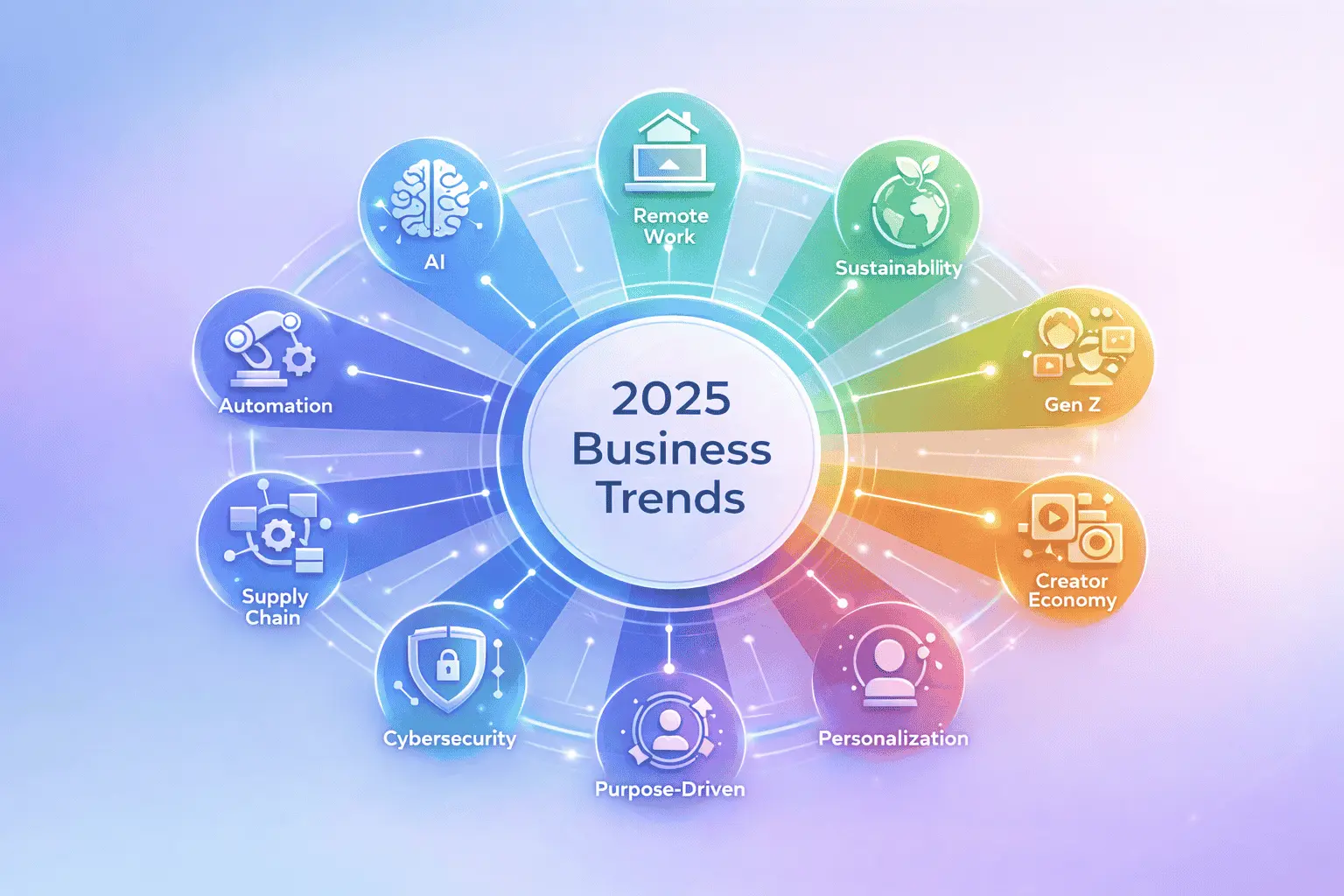
How Businesses Can Adapt to These Trends
Understanding trends is necessary but insufficient—execution determines success. Here's how to strategically adapt your organization to the business trends 2025 reshaping the competitive landscape.
Strategic Planning Tips
Conduct comprehensive trend audits across all ten areas covered in this article. Objectively assess where your organization stands—not where you wish you were or where competitors claim to be. Identify both immediate vulnerabilities (areas where you're significantly behind) and strategic opportunities (areas where you could differentiate).
Prioritize based on impact and urgency. Not all trends affect every business equally. A B2B industrial manufacturer faces different pressures than a consumer retail brand. Evaluate which trends most significantly impact your specific industry, customer base, and competitive positioning. Focus resources where they'll deliver maximum strategic advantage.
Set specific, measurable objectives for each priority trend. Avoid vague aspirations like "improve AI adoption" in favor of concrete goals like "implement AI-powered customer service chatbot handling 40% of tier-1 inquiries within six months." Specific targets enable accountability and resource allocation.
Allocate budget strategically. Trend adaptation requires investment—in technology, talent, training, and transformation. Build business cases demonstrating expected ROI and secure funding accordingly. Remember that not investing carries opportunity costs as competitors gain advantages.
Establish cross-functional teams for trend initiatives. AI integration, sustainability transformation, or Gen Z strategy shouldn't live in single departments. Create teams spanning relevant functions—technology, operations, marketing, finance—with executive sponsors ensuring organizational priority.
Implementation Roadmap
Phase 1: Assessment and Foundation (Months 1-3)
- Conduct comprehensive audits across all trend areas
- Benchmark against competitors and industry leaders
- Identify quick wins delivering immediate value
- Build business cases for major initiatives
- Secure executive buy-in and budget allocation
Phase 2: Pilot Programs (Months 4-6)
- Launch contained pilot programs in 2-3 high-priority areas
- Test approaches with limited risk and investment
- Measure results rigorously against success criteria
- Gather employee and customer feedback
- Document lessons learned for scaling
Phase 3: Scaling Success (Months 7-12)
- Expand successful pilots to broader organization
- Develop training and change management programs
- Invest in necessary infrastructure and technology
- Establish metrics and dashboards for ongoing monitoring
- Iterate based on results and feedback
Phase 4: Continuous Evolution (Months 13+)
- Embed successful initiatives into standard operations
- Expand into additional trend areas based on priorities
- Monitor emerging developments and adjust strategies
- Share best practices across organization
- Celebrate wins and maintain momentum
Change Management Advice
Communicate early, often, and honestly. Employees fear ambiguity more than bad news. Explain why changes matter, how they'll affect individuals and teams, and what support the organization will provide. Address concerns directly rather than ignoring them.
Involve employees in transformation. People support what they help create. Solicit input from front-line staff who understand current processes intimately. Create pilot teams representing diverse perspectives. Recognize that resistance often stems from legitimate concerns worth addressing.
Invest heavily in training and support. Introducing new technologies or processes without adequate preparation sets up failure. Provide comprehensive training, ongoing support, and time for employees to adapt. Celebrate progress and acknowledge challenges.
Lead from the top. Executive teams must visibly champion transformation initiatives. When leadership demonstrates commitment through resource allocation, personal involvement, and sustained attention, organizations follow. Conversely, half-hearted executive support dooms initiatives.
Measure and share progress. Create visible scorecards tracking initiative progress against goals. Celebrate milestones publicly. Share success stories and lessons learned. Transparency builds trust and maintains momentum through inevitable challenges.
Accept imperfection. No transformation executes flawlessly. Anticipate setbacks, learn from failures, and adjust approaches. Organizations that demand perfection stall; those that embrace iterative improvement succeed.
Protect culture while transforming operations. Change threatens organizational culture if poorly managed. Articulate which cultural elements are sacred and will be preserved, and which must evolve. Help people understand that adaptation strengthens rather than betrays core values.
The organizations thriving in 2025 and beyond aren't those that perfectly predict every trend—they're those that build adaptive capacity to respond quickly when the landscape shifts. Strategic planning, disciplined execution, and effective change management transform understanding into competitive advantage.
Expert Predictions: Looking Beyond 2025
Industry leaders and analysts offer compelling perspectives on how current business trends 2025 will evolve over the coming years.
James Landay, Stanford's Human-Centered AI Institute, observes we're shifting "from AI evangelism to AI evaluation." The question evolves from "Can AI do this?" to "How well, at what cost, and for whom?" Expect standardized benchmarks, real-time labor displacement dashboards, and clinical frameworks bringing rigor to AI assessment.
Peter Lee, Microsoft Research President, predicts AI will actively join scientific discovery processes in physics, chemistry, and biology. "AI will generate hypotheses, use tools that control scientific experiments, and collaborate with both human and AI research colleagues." This represents AI transitioning from tool to colleague.
Jared Feldman, Fora Financial CEO, notes regarding business financing: "Today's business owners must be more strategic than ever. Access to capital remains competitive, but businesses demonstrating solid fundamentals, clear growth plans, and adaptability to market changes will continue securing investment."
Rory Burghes, Capgemini Invent, predicts sustainability narratives will shift dramatically: "The conversation moves from 'growth vs sustainability' to 'growth through sustainability,' with markets increasingly rewarding companies that link financial results to measurable environmental impact."
Goldman Sachs economists project AI could lift global GDP by 15% over the next decade—equivalent to $15 trillion in economic value creation. However, they acknowledge significant transition challenges as labor markets adjust to technological displacement and workforce transformation.
McKinsey research suggests that by 2030, between 400-800 million jobs globally could be displaced by automation, but an equal or greater number of new jobs will emerge requiring different skills. The winners will be organizations investing now in workforce development and transition programs.
Gartner predicts that 40% of enterprise applications will leverage task-specific AI agents by year-end 2026, up from less than 5% in 2025. This represents the most dramatic shift in enterprise software architecture since cloud computing emerged.
The consensus among experts: the trends reshaping business in 2025 will accelerate rather than stabilize. Organizations building adaptive capacity, investing in continuous learning, and maintaining strategic flexibility will navigate uncertainty successfully. Those waiting for stability before acting will find themselves perpetually behind.
Conclusion
The ten business trends 2025 explored in this guide aren't isolated phenomena—they're interconnected forces reshaping the entire business landscape. AI enables personalization at scale. Gen Z preferences drive creator economy growth. Remote work demands cybersecurity rigor. Sustainability requirements influence supply chain decisions. Each trend amplifies others, creating compound effects that reward early adaptation.
The organizations thriving in 2025 and beyond share common characteristics: they act decisively on credible intelligence rather than waiting for certainty. They invest in their people as much as their technology. They balance short-term efficiency with long-term resilience. They define clear purpose beyond profit while maintaining financial discipline. They embrace change as constant rather than exception.
Your competitive advantage lies not in knowing these trends exist—everyone has access to the same information. Your advantage comes from acting faster, executing better, and adapting more effectively than competitors. The gap between understanding and implementation determines who leads and who follows.
Start today. Choose one trend from this article that most directly impacts your business. Set one specific, measurable objective. Allocate resources. Launch a pilot program. Measure results. Learn. Iterate. Scale. The journey from awareness to advantage begins with the first step.
At Findsfy, we're committed to keeping you informed as these trends evolve and new patterns emerge. The business landscape will continue transforming—ensuring you have the insights, analysis, and practical guidance to navigate change successfully is our mission.
The future belongs to the adaptive. Which trends will you master first?
Frequently Asked Questions (FAQs)
Which business trend should I prioritize first?
Prioritize trends directly impacting your competitive position and customer satisfaction. Most businesses should start with AI integration for immediate productivity gains, followed by trends specific to their industry.
How much should small businesses invest in these trends?
Start with low-cost implementations using existing tools. Many trends require strategic thinking more than large budgets. Pilot programs costing $500-$5,000 can validate approaches before scaling investment.
Will AI really replace human workers?
AI augments rather than replaces humans. It eliminates tedious tasks, allowing focus on strategic, creative work. The World Economic Forum projects net job growth through 2030 despite automation.
How can I attract Gen Z customers and employees?
Demonstrate authentic values through transparent practices, maintain strong social media presence with genuine engagement, offer flexible work arrangements, and prioritize sustainability. Gen Z detects and punishes inauthenticity quickly.
Is remote work still effective long-term?
Yes, when implemented strategically. Hybrid models combining remote focused work with in-person collaboration deliver both productivity gains and culture benefits. The key is intentional design matching work type to location.