

Private market investing builds diversified portfolios beyond traditional stocks and bonds. Alternative investments offer unique advantages unavailable in public markets. These opportunities create value through different mechanisms than publicly traded securities. This comprehensive guide covers private market investing from fundamental concepts to practical implementation strategies. You'll learn what private market investing entails, explore various asset classes, and discover platform options expanding access. Private market investing suits qualified investors seeking enhanced returns and true portfolio diversification. Strategic allocation to alternatives can improve risk-adjusted performance. Understanding these investments positions you for long-term success. Let's explore private markets thoroughly.
Understanding Private Market Investing
Definition and Core Concepts
What is private market investing? Private market investing involves capital allocation to non-publicly traded assets. These investments don't trade on public exchanges like the NYSE or NASDAQ. The category includes private equity, private credit, and private-market real estate investing. Investors gain direct ownership stakes in companies or assets. This represents an alternative to traditional public stock and bond markets.
Private market investments typically involve longer holding periods than public securities. Liquidity characteristics differ fundamentally from stocks and bonds. Professional management frequently structures and oversees these investments. The illiquidity premium—additional returns compensating for reduced liquidity—represents a core appeal of private market investing.
Private Markets vs Public Markets
Understanding the distinctions between private equity investment vs public market investing proves essential for allocation decisions.
Liquidity Differences: Private markets feature limited liquidity with lockup periods ranging from 5-12 years. Public markets offer daily trading and immediate liquidity. The illiquidity premium in private markets historically provides 2-4% additional annual returns.
Transparency Variations: Private investments involve limited public information disclosure. Public markets require extensive regulatory filings and transparency. However, private market investing often provides direct access to company management teams.
Valuation Methods: Private assets receive periodic valuations, typically quarterly. Public markets feature real-time pricing. Private market valuations show less volatility in reported marks, though this reflects appraisal timing rather than true stability.
Access Requirements: Private market investing requires accredited investor status with minimum income or net worth thresholds. Public markets remain open to all investors. Private investments also demand higher capital commitments, traditionally $250,000 to $1 million minimum.
Why Private Market Investing Matters
Private market investing provides portfolio benefits unavailable through public securities alone. Diversification beyond public markets accesses different return drivers. Lower correlation to stock market volatility reduces overall portfolio risk. Historical data suggests potential for higher risk-adjusted returns. Inflation protection opportunities exist through real assets. Early access to high-growth companies before public listing creates value. Operational improvements rather than market sentiment drive returns.
Institutional investors allocate 20-30% of portfolios to private markets. Sophisticated individual investors increasingly follow this model as access expands.
Private Market Asset Classes
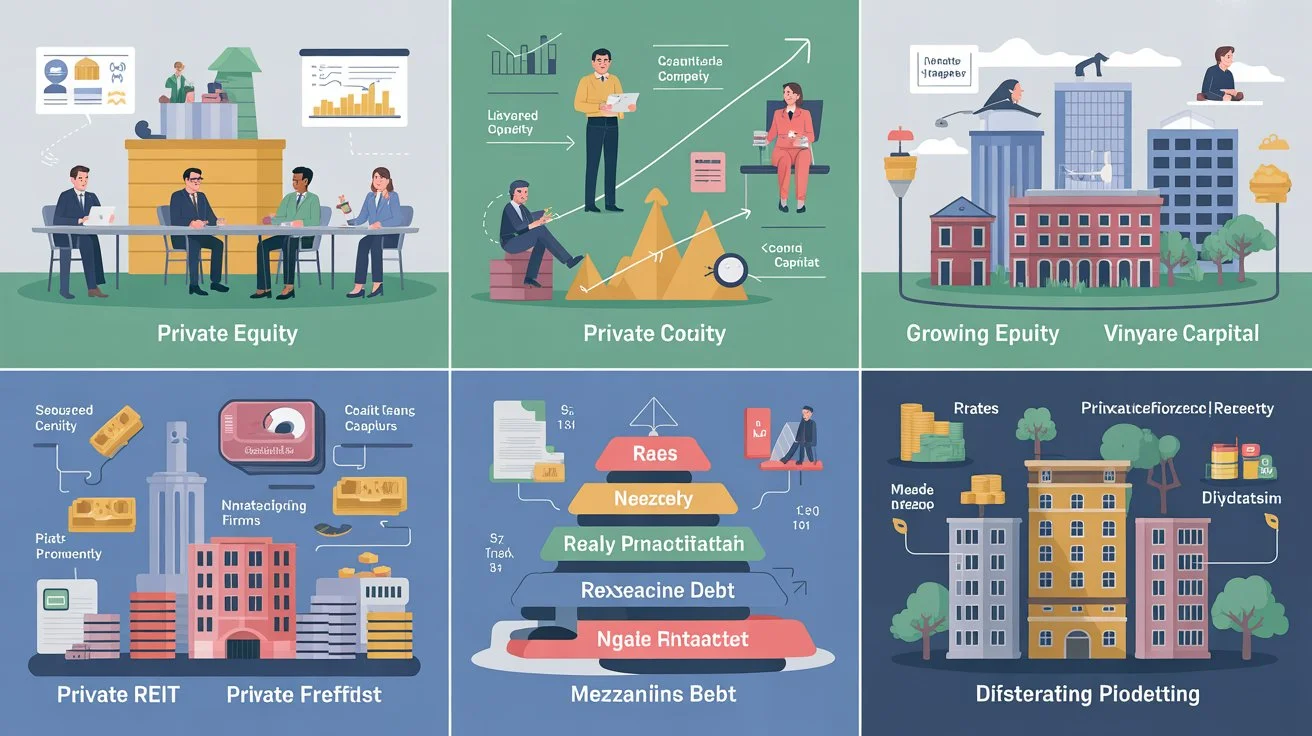
Private Equity
Private equity involves direct ownership in private companies. Fund structures pool capital from multiple investors. Buyout funds acquire majority or complete ownership stakes. Growth equity provides expansion capital for established companies. Value creation occurs through operational improvements, not just market appreciation. Typical holding periods span 5-7 years. Target returns range from 15-25% IRR (internal rate of return).
Leveraged Buyouts (LBOs): Acquire established profitable companies using significant leverage. Focus intensely on operational improvements and efficiency gains. Management teams work closely with portfolio companies. Exits occur through strategic sales or initial public offerings.
Growth Equity: Takes minority stakes in growing companies requiring expansion capital. Uses less leverage than traditional buyouts. Focuses on supporting management's growth initiatives. Technology and healthcare sectors receive significant attention. Targets later-stage private companies approaching maturity.
Venture Capital: Invests in early-stage companies with high growth potential. Carries high risk but offers substantial return potential. Involves multiple funding rounds from Seed through Series A, B, C, and beyond. Technology sector concentration remains pronounced. Portfolio approach essential as many investments fail but winners generate outsized returns.
Private Credit
Private credit provides alternative financing to companies outside traditional banking. Direct lending to middle-market companies represents the largest segment. These loans offer higher yields than public bonds. Floating rate structures protect against interest rate increases. Secured senior debt provides downside protection. Current income generation appeals to income-focused investors.
Distressed Debt: Invests in troubled companies trading at significant discounts. Requires specialized expertise in restructuring. Higher risk profiles demand substantial return premiums. Often involves active participation in company turnarounds.
Mezzanine Financing: Hybrid debt-equity structures fill capital stack gaps. Subordinated to senior debt but includes equity participation through warrants or options. Targets returns between senior debt and equity. Finances growth initiatives and acquisitions.
Private-Market Real Estate Investing
Private-market real estate investing provides exposure to income-producing properties outside public REITs. This asset class deserves particular attention given its accessibility and portfolio benefits.
Private REITs (Non-Traded): Real estate portfolios not listed on exchanges. Generate steady income through property rents. Offer diversification across multiple properties and sectors. Professional management teams handle operations. Lower volatility than exchange-traded REITs due to appraisal-based valuations. Various liquidity terms and redemption structures exist.
Real Estate Private Equity: Direct property investments pursuing value-add or opportunistic strategies. Includes ground-up development and significant renovations. Higher return targets than core real estate. Increased risk profiles require sophisticated evaluation.
Real Estate Debt: Mortgage loans secured by commercial properties. Mezzanine real estate debt offers higher yields with additional risk. Focus on current income generation. Senior position in capital stack provides relative safety.
Commercial Real Estate Direct Ownership: Direct ownership of specific properties across office, retail, industrial, or multifamily sectors. Provides maximum control over asset management. Requires significant capital and active management. Concentration risk higher than diversified funds.
Alternative Private Market Investments
Private Infrastructure: Investments in essential assets like roads, utilities, and communications networks. Long-term stable cash flows with inflation protection. Essential service nature provides downside resilience.
Natural Resources: Timberland, farmland, agriculture, and energy partnerships. Inflation hedging characteristics. Long-term value appreciation potential.
Secondaries: Purchases of existing fund interests from original limited partners. Provides shorter duration to distributions. Often available at discounted pricing. Offers immediate diversification across vintage years.
Private Equity Investment vs Public Market Investing
Return Characteristics Comparison
Historical performance data shows private equity averaging 14-16% returns over 20-year periods. Public equity (S&P 500) generated 10-12% over comparable timeframes. The illiquidity premium explains 2-4% of this differential. Top quartile private equity managers achieve 20%+ returns, while bottom quartile significantly underperforms.
Return drivers differ fundamentally. Private equity creates value through operational improvements, financial engineering with leverage, revenue growth initiatives, cost reduction programs, and strategic repositioning. Multiple expansion at exit amplifies returns. Public market returns depend more on market sentiment, company earnings growth, dividend payments, and economic cycles.
Risk Comparison
Private market investing carries distinct risks. Illiquidity risk prevents easy exit from investments. Capital call risk requires maintaining reserves for unfunded commitments. Manager selection proves critical given wide performance dispersion. Valuation marks occur quarterly rather than daily. Concentration risk exists due to fewer portfolio holdings.
Public markets feature daily volatility and price swings. However, liquidity exists even during stress periods for most securities. Correlation among public securities limits diversification benefits. Sentiment-driven pricing creates opportunities and risks. Information asymmetry remains less severe than in private markets.
Investment Structure Differences
Private equity structures as limited partnerships with 10-12 year fund lives. Capital gets called over 3-5 year investment periods creating J-curve effects. Fee structures typically include 2% annual management fees and 20% carried interest on profits above hurdle rates. Quarterly valuations and reporting occur. Minimum investments range from $250,000 to $1 million for traditional funds.
Public market structures offer direct ownership with no predetermined timeline. Immediate full investment deployment occurs. Management fees range from 0.05-1%, substantially lower than private markets. Real-time pricing provides constant portfolio visibility. No minimum investments required.
Diversification Benefits
Private markets demonstrate low correlation to public equities and bonds. This reduces overall portfolio volatility when combined with traditional assets. Access to completely different opportunity sets expands investment options. Institutional portfolios typically allocate 20-30% to private markets. Sophisticated individual investors increasingly target 10-40% allocations. University endowments and pension funds maintain heavy private market exposure given long-term investment horizons.
Accessing Private Markets: Platform Options
Traditional Private Market Access
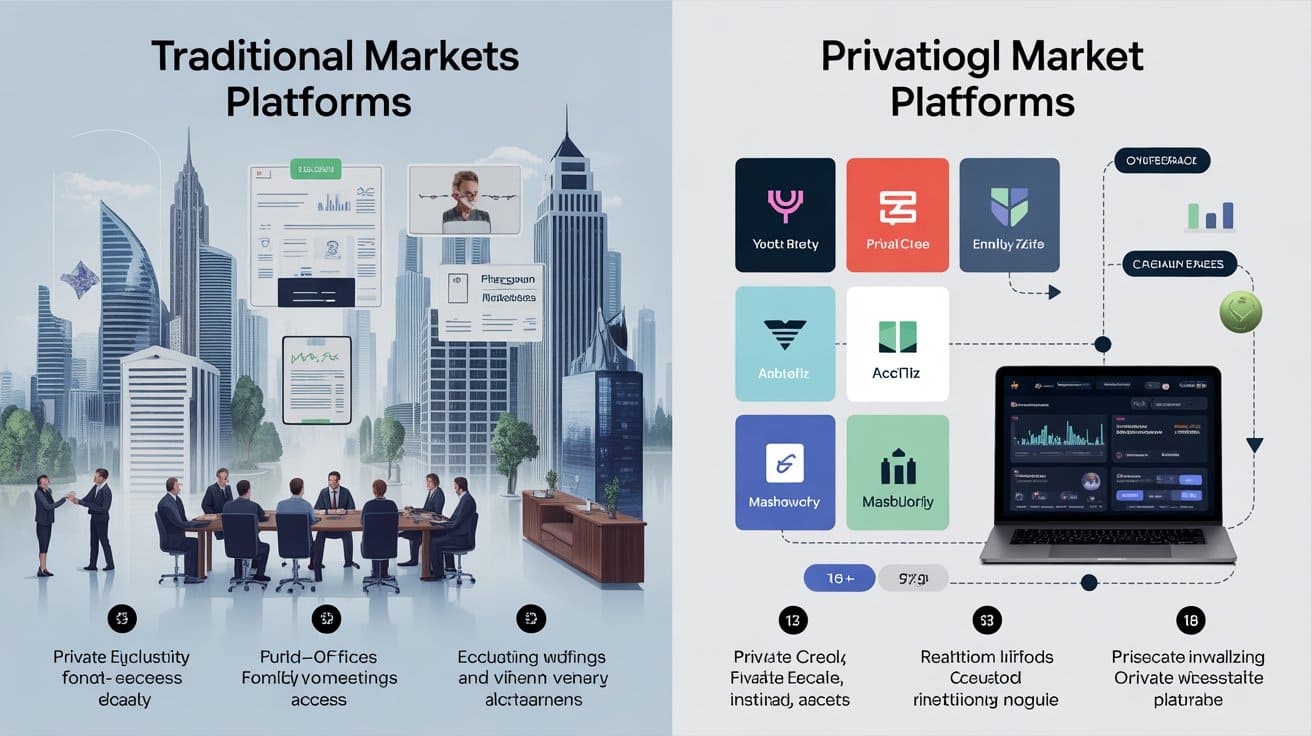
Traditional private market investing required substantial capital and relationships. Direct fund investments with established managers like Blackstone, KKR, and Apollo demand $5-25 million minimum commitments. These institutional-quality funds offer highest-quality deal flow but remain exclusive.
Fund of funds structures lower minimums to $100,000-$500,000. Professional manager selection provides instant diversification across multiple underlying funds. Additional fee layers exist but concentration risk decreases. Family offices and wealth managers curate opportunities and negotiate access for clients.
Private Market Investing Platform Technology
Technology platforms have democratized private market investing access for accredited investors. Online private market investing platforms reduce traditional barriers through lower minimums, simplified processes, and broader accessibility.
Leading Private Market Investing Platforms:
Yieldstreet: Alternative investment marketplace featuring private-market real estate investing, private credit, art, and other alternatives. Typical minimums range $10,000-$15,000. Accredited investor verification required. Offers shorter-duration opportunities than traditional funds.
Cadre: Private-market real estate investing platform providing institutional-quality commercial property access. Minimums typically $25,000-$50,000. Direct property investment structures. Technology-driven sourcing and underwriting.
EquityZen: Pre-IPO secondary marketplace for startup equity. Access to unicorn companies before public listing. $10,000-$20,000 minimums. Provides liquidity solutions for employees and early investors.
AngelList: Venture capital access through rolling funds and syndicates. Some offerings available from $1,000-$10,000. Technology startup focus. Fund manager selection remains critical to success.
Masterworks: Fine art investing platform enabling fractional artwork ownership. $10,000-$15,000 typical minimums. 3-10 year expected holding periods. Alternative asset class diversification.
RealtyMogul: Private-market real estate investing across commercial properties. Offers both REIT structures and individual deals. $5,000-$25,000 minimums. Income and appreciation strategies available.
Platform Selection Criteria
Evaluate private market investing platforms thoroughly before committing capital. Examine platform track record and operational history. Assess fee structures for transparency and competitiveness. Analyze deal quality and sourcing capabilities. Review manager experience and expertise. Verify investor protections and alignment mechanisms. Understand liquidity options and restrictions. Examine reporting standards and transparency. Evaluate customer service and support quality. Confirm regulatory compliance and oversight. Consider minimum investment requirements relative to portfolio size.
Accredited Investor Requirements
Private market investing platforms require accredited investor status. Qualification standards include annual income of $200,000 individually or $300,000 jointly for the past two years with expectation of continuation. Alternatively, net worth exceeding $1 million excluding primary residence qualifies. Professional certifications like Series 7, 65, or 82 licenses qualify holders. Entity investments require meeting qualified institutional standards. Verification processes confirm status. State-specific requirements may apply.
Private-Market Real Estate Investing Strategies
Why Private Real Estate?
Private-market real estate investing offers compelling portfolio benefits. Tangible assets possess intrinsic value. Income generation through tenant rents provides cash flow. Property appreciation potential exists over time. Inflation hedging occurs as rents and values rise with inflation. Tax advantages include depreciation deductions and 1031 exchange opportunities. Portfolio diversification benefits from low correlation to stocks and bonds. Lower reported volatility than equities due to appraisal-based valuations. Leverage amplifies returns when used prudently.
Private Real Estate Investment Structures
Direct Property Ownership: Purchase specific commercial properties directly. Provides full control over asset management decisions. Establishes direct tenant relationships. Requires significant capital, typically $1 million minimum. Involves active property management responsibilities. Concentration risk higher than diversified approaches. Offers maximum transparency and control.
Private Real Estate Funds: Pooled capital structures diversifying across multiple properties. Professional management teams handle all operations. Typical minimums range $250,000-$1 million. Strategies span core, value-add, and opportunistic risk-return profiles. Investors function as limited partners. Receive quarterly reporting and valuations.
Private REITs (Non-Traded): Portfolios of income-producing properties not listed on exchanges. Monthly or quarterly distribution payments to investors. Minimum investments often $1,000-$25,000, dramatically lower than direct ownership or funds. Professional management handles all operations. Less daily volatility than exchange-traded REITs. Various redemption terms and liquidity windows exist. Popular private-market real estate investing option for qualified individuals.
Real Estate Syndications: Single property or small portfolio investments. Sponsor (general partner) identifies and manages investment. Investors (limited partners) provide capital. $25,000-$100,000 typical minimums. Defined hold periods typically 3-7 years. Preferred returns of 6-8% often structured. Profit sharing after hurdle rates achieved.
Private Real Estate Sectors
Commercial property types each offer distinct characteristics. Multifamily apartment complexes provide consistent demand and cash flow. Shorter lease terms offer flexibility but require more management. Industrial/logistics warehouses benefit from e-commerce growth. Long-term triple-net leases reduce management burden. Office properties face remote work headwinds in some markets. Credit quality tenants and lease lengths matter significantly. Retail faces e-commerce disruption but essential retail outperforms. Specialty sectors include self-storage, data centers, healthcare properties, student housing, and hospitality, each with unique risk-return profiles.
Private Real Estate Risk Management
Due diligence for private-market real estate investing requires comprehensive analysis. Property inspection assesses physical condition. Market analysis evaluates demographics and economic trends. Tenant credit review and lease analysis confirm income stability. Environmental assessments identify potential liabilities. Title and survey review ensure clean ownership. Financing terms impact returns significantly. Exit strategy planning before purchase proves essential.
Risk factors include market cycle timing, interest rate sensitivity, tenant concentration, property-specific issues, liquidity constraints, management execution capability, geographic concentration, and leverage magnification of both gains and losses.
Private Market Investment Due Diligence
Manager Due Diligence
Track record analysis examines historical fund performance across key metrics: IRR, TVPI (total value to paid-in capital), and DPI (distributions to paid-in capital). Evaluate consistency across market cycles. Compare performance to relevant benchmarks from Cambridge Associates or Preqin. Analyze vintage year diversification. Examine net returns after all fees. Review loss ratios and write-offs.
Team evaluation assesses investment professional experience and stability. Industry expertise and networks matter significantly. Team turnover raises concerns. Succession planning ensures continuity. Investment committee structure impacts decision quality. Alignment of interests through personal co-investment signals confidence.
Operational due diligence reviews firm infrastructure and resources. Compliance and regulatory history reveal potential issues. Valuation policies and procedures impact reported performance. Conflict of interest management protects investors. Fund administration quality ensures accurate reporting.
Deal-Level Due Diligence
Investment thesis review evaluates value creation strategy clarity. Market opportunity assessment confirms addressable market size. Competitive positioning analysis determines sustainable advantages. Management team quality drives execution capability. Financial projections must demonstrate reasonability. Risk factor identification highlights potential challenges. Exit strategy viability determines ultimate realization prospects.
Financial analysis examines historical performance and quality of earnings. Working capital requirements and capital expenditure needs impact cash flow. Debt structure and covenants create constraints or flexibility. Sensitivity analysis tests downside scenarios. Return calculations verify IRR, cash-on-cash returns, and equity multiples.
Legal and structural review includes fund documents (Limited Partnership Agreement, Private Placement Memorandum). Fee structures and economics require scrutiny. GP/LP alignment mechanisms protect investor interests. Redemption and liquidity terms impact flexibility. Tax structure efficiency affects net returns.
Red Flags to Watch
Warning signs demand additional scrutiny or investment avoidance. Overly aggressive return projections without justification. Lack of transparency in reporting and communication. High team turnover suggesting internal issues. Poor track record or complete absence of track record. Excessive fees and hidden costs beyond disclosed structures. Misalignment between GP and LP interests. Regulatory issues or enforcement actions. Pressure to invest quickly without adequate diligence time. Unclear investment strategy or frequent strategy changes. Limited investor protections in fund documents.
Professional Advisor Involvement
Engage professional advisors for first-time private market investing, large commitments, complex structures, unclear tax implications, legal document review needs, and portfolio construction guidance. Financial advisors operating as fiduciaries provide objective counsel. Private market consultants offer specialized expertise. Investment attorneys review legal documents. Tax professionals navigate K-1 complexity. Third-party due diligence firms conduct independent analysis.
Private Market Portfolio Construction
Allocation Strategy
Portfolio allocation to private markets depends on individual circumstances, risk tolerance, and liquidity needs.
Conservative (10-20% private markets): Appropriate for primarily public market investors with limited liquidity flexibility. First-time private market exposure should emphasize lower-risk strategies. Core private real estate and private credit provide income. Gradual scaling builds comfort and understanding.
Moderate (20-35% private markets): Balanced approach combining public and private investments. Requires adequate liquidity reserves for capital calls. Diversifies across multiple private asset classes. Mixes private equity and credit. Approaches institutional-style allocation.
Aggressive (35-50%+ private markets): Suited for sophisticated investors with significant liquid reserves. Requires long investment horizons exceeding 10 years. Enables broad private market diversification across strategies. Follows university endowment model approach.
Diversification Strategies
Asset class diversification spreads exposure across private equity (buyout and growth), private credit (senior and subordinated), private-market real estate investing (various sectors), venture capital (small allocations given risk), infrastructure and natural resources, and secondaries for near-term distributions.
Manager diversification reduces concentration risk. Invest with multiple fund managers demonstrating different investment styles and approaches. Include varying firm sizes from established mega-funds to emerging managers. Pursue geographic diversity across regions. Vintage year diversification staggers commitment timing across market cycles.
Stage and strategy diversification spans early-stage through late-stage investments. Include core through opportunistic risk-return profiles. Balance domestic and international exposure. Combine income-focused and growth-oriented strategies. Construct different risk-return profiles within private allocation.
J-Curve Management
Understanding cash flow timing proves essential in private market investing. Early years feature capital calls exceeding distributions as management fees and expenses drag initial returns. Investments mature over 3-7 years before significant value creation materializes. Later years produce accelerating distributions as exits occur. Portfolio-level smoothing through proper staging reduces cash flow volatility.
Stage capital commitments over multiple years rather than all at once. Implement 3-5 year commitment pacing. Maintain 2-3x uncalled commitments relative to portfolio value. Avoid over-committing during initial enthusiasm. Build substantial liquidity reserves.
Liquidity Planning
Maintain adequate liquidity by retaining 2-3 years of expected capital calls in liquid investments. Separate emergency reserves from commitment capital. Understand secondary market exit options exist but require accepting significant discounts to NAV. Consider portfolio lines of credit for bridging capital calls. Stagger fund vintages to create eventual distribution timing diversity.
Performance Monitoring
Track private investments through quarterly valuation report review. Monitor capital account activity and cash flows. Calculate and review TVPI, DPI, and RVPI (residual value to paid-in) metrics. Compare performance to relevant benchmarks from Cambridge Associates or Preqin. Maintain regular manager communication. Rebalance portfolio as asset values change and new opportunities emerge.
Tax Implications of Private Market Investing
Tax Structure of Private Investments
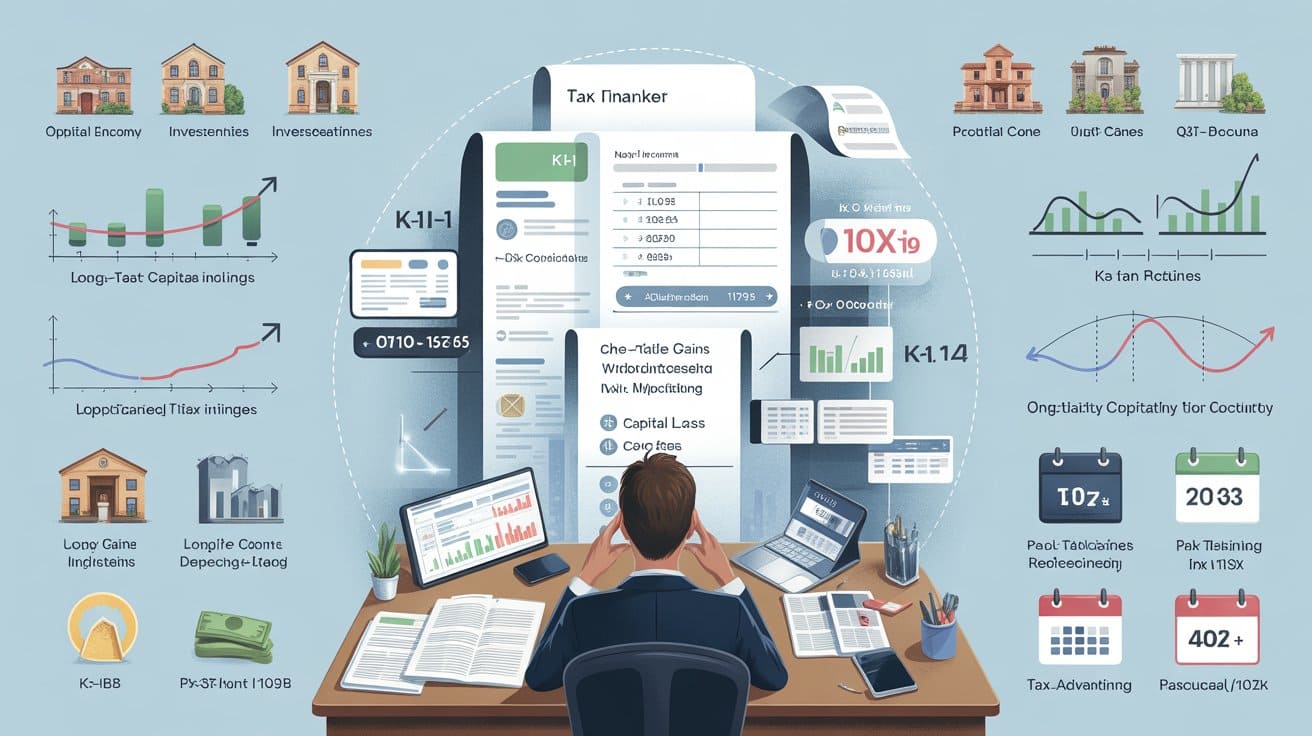
Private market investing typically involves pass-through taxation via partnership structures. Investors receive K-1 tax forms rather than 1099s. Income includes ordinary income, capital gains, and potentially losses. Unrelated business taxable income (UBTI) may apply when funds use debt financing. Multi-state tax filing requirements often arise. Complex tax reporting demands professional assistance. Late K-1 delivery commonly delays personal tax filing.
Tax Benefits
Depreciation deductions from real estate investments reduce taxable income. Long-term capital gains treatment applies to profits from holdings exceeding one year. Opportunity zone investments offer tax deferral and elimination benefits. Tax-deferred 1031 exchanges enable real estate reinvestment. Self-directed IRA and 401(k) structures allow tax-advantaged private investing. Qualified small business stock (QSBS) exclusions may apply to certain venture investments.
Tax Planning Strategies
Retirement account private investing offers tax advantages but requires careful UBTI management. Opportunity zone fund allocation provides substantial tax benefits. Donor-advised fund contributions of appreciated private interests generate deductions. Charitable remainder trusts create income streams while benefiting charities. Loss harvesting opportunities offset gains from successful investments. Entity structure selection (LLC, partnership, trust) optimizes tax treatment.
Tax Professional Guidance
Consult qualified CPAs for first private market investments. Multiple K-1 forms create significant complexity. Multi-state tax implications require specialized knowledge. UBTI concerns in retirement accounts demand expertise. Estate planning with illiquid private assets needs professional guidance. International private investments involve additional complexity.
Understanding Private Market Investment Risks
Illiquidity Risk
Capital commits for 5-12 years in typical private funds. No ability to exit investments early without significant costs. Secondary market sales of fund interests occur at 10-30% discounts to NAV. Requires genuinely long-term perspective. Emergency liquidity planning becomes essential when substantial capital commits to private markets.
Capital Call Risk
Fund structures call capital over time rather than investing everything upfront. Must maintain liquid reserves for unpredictable capital calls. Defaulting on capital calls triggers penalties including investment forfeiture and legal action. Uncertain timing complicates cash planning. Multiple fund commitments compound planning complexity.
Valuation and Transparency
Quarterly valuations replace real-time pricing. Manager discretion influences reported marks. Valuations lag true value changes. Limited portfolio transparency compared to public securities. Appraisal-based valuations smooth volatility artificially. Less frequent reporting than public investments.
Manager and Execution Risk
Performance dispersion between top and bottom quartile managers exceeds 10-15 percentage points annually. Manager selection proves absolutely critical to success. Operational execution capability determines results. Portfolio company challenges impact returns significantly. Exit timing and market conditions matter substantially. Due diligence quality correlates directly with outcomes.
Concentration Risk
Private portfolios hold fewer positions than diversified public portfolios. Single investment failures meaningfully impact overall returns. Geographic or sector concentration creates correlated risks. Manager concentration risk when over-allocating to single firm. Building adequate diversification requires time and multiple commitments across vintage years.
Regulatory and Legal Risks
Accredited investor verification creates access barriers. Suitability requirements restrict some investors. Regulatory changes impact structure availability and terms. Fund document complexity obscures important terms. Investor protections less robust than public securities. Fraudulent offering risk higher in private markets despite regulations.
Private Market Trends and Outlook 2026
Democratization of Access
Technology platforms continue lowering minimum investments for private market investing. Retail accredited investor participation increases annually. Regulatory changes enable broader access through interval funds and tender offer structures. Investment processes simplify through digitization. Educational resources proliferate online. Barriers to entry decrease substantially but qualification requirements remain.
Market Trends
Private market assets under management exceed $15 trillion globally in 2026. Institutional allocation targets increase toward 30-40% of portfolios. Infrastructure investment experiences boom driven by climate and technology needs. Healthcare and life sciences attract significant capital. Technology sector maturation creates opportunities across stages. ESG integration becomes standard in private market investing. Climate-focused investment grows rapidly.
Innovation in Private Markets
Emerging developments reshape access and structures. Blockchain technology and tokenization promise enhanced liquidity. Secondary market solutions expand providing exit options. Artificial intelligence enhances due diligence efficiency. Direct indexing approaches for private markets emerge. Subscription credit facilities smooth capital call timing. Continuation funds extend successful investment hold periods. GP-led secondaries grow as portfolio management tools.
Getting Started
Take action by educating yourself thoroughly on private market investing fundamentals. Assess financial qualification under accredited investor standards. Define clear investment objectives aligned with time horizon and risk tolerance. Build substantial liquidity reserves before committing to private markets. Start with lower-risk strategies like private credit or core real estate. Diversify across managers and vintage years from inception. Maintain genuinely long-term perspective. Consult qualified financial advisors specializing in alternative investments.
Private Market Investing: Strategic Portfolio Enhancement
Private market investing offers qualified investors unique portfolio diversification opportunities unavailable in public markets. Multiple asset classes spanning private equity, credit, and real estate provide varied risk-return profiles. Platform technology expands access through reduced minimums and simplified processes. Understanding the private equity investment vs public market investing distinction enables informed allocation decisions. Comprehensive due diligence and realistic return expectations prove essential for success.
Private-market real estate investing deserves particular consideration given accessibility and portfolio benefits. What is private market investing ultimately? It represents strategic exposure to different return drivers with potential for enhanced risk-adjusted performance through illiquidity premium capture. The private market investing platform landscape continues evolving, democratizing access previously reserved for institutions.
Ready to explore private market investing? Start by confirming accredited investor status and building adequate liquidity reserves. Research leading private market investing platforms and compare offerings, fees, and track records. Consult financial advisors specializing in alternative investments for portfolio construction guidance. Download allocation frameworks to determine appropriate private market exposure for your specific situation. Begin with education before capital commitment. Your private market journey starts with thorough preparation.
Frequently Asked Questions About Private Market Investing
Q: What is private market investing?
Private market investing involves capital allocation to non-publicly traded assets including private equity, private credit, and real estate. These investments offer potential for enhanced returns through illiquidity premiums, portfolio diversification beyond public securities, and access to unique opportunities requiring accredited investor status and longer holding periods.
Q: What is a private market investing platform?
A private market investing platform connects accredited investors with alternative investment opportunities through technology-enabled marketplaces. These platforms lower traditional barriers by reducing minimum investments from $1 million+ to $10,000-$100,000, simplifying subscription processes, and providing access to private equity, real estate, and venture capital deals previously exclusive to institutions.
Q: How does private equity investment vs public market investing compare?
Private equity historically returns 14-16% annually versus 10-12% for public markets, compensating for illiquidity. Private markets require 5-12 year lockups, higher minimums ($250K+), and accredited status. Public markets offer daily liquidity, lower fees, and universal access. Private equity creates value through operational improvements; public markets depend more on sentiment.
Q: What is private-market real estate investing?
Private-market real estate investing provides ownership interests in commercial properties through direct purchase, private REITs, funds, or syndications—not traded on exchanges. Investors gain income from rents, appreciation potential, tax benefits through depreciation, portfolio diversification, and inflation hedging. Minimum investments range $10,000-$1 million depending on structure selected.
Q: What are the main risks of private market investing?
Primary risks include illiquidity (5-12 year lockups with no early exit), capital call obligations requiring liquidity reserves, manager selection challenges given wide performance dispersion, valuation uncertainty with quarterly marking, concentration from fewer holdings, and regulatory requirements. Potential principal loss exists. Professional guidance essential for qualified investors.