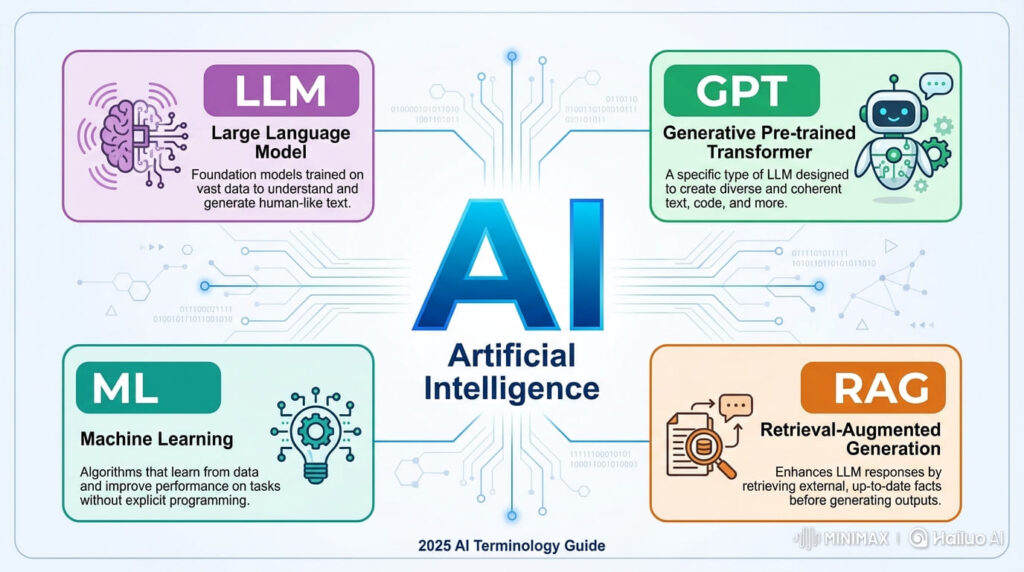
AI stands for Artificial Intelligence. This term is everywhere today—in news headlines, at work, and in everyday conversations. But AI comes with many confusing acronyms. You've probably seen LLM, GPT, and RAG too. What do these letters mean? This guide explains what does ai stand for and decodes essential AI terms & tools. No technical background needed. We'll make everything clear and simple. Get ready to understand AI language.
What Does AI Stand For? The Basic Definition
AI = Artificial Intelligence
Let's start with the basics. What does AI stand for? AI stands for Artificial Intelligence. Breaking this down is simple. "Artificial" means made by humans, not natural. "Intelligence" means the ability to learn, reason, and solve problems. Put them together, and you get computer systems that can think and learn like humans.
What Is Artificial Intelligence?
Artificial intelligence is technology that performs tasks requiring human-like thinking. These are machines that can learn from experience, recognize patterns, make decisions, and solve problems. AI systems analyze information and improve over time without being explicitly programmed for every scenario.
Why It's Called AI
The term "artificial intelligence" was coined in 1956 at a conference at Dartmouth College. Scientists wanted to create machines that could think. Their goal was to replicate human intelligence in computers. The name stuck and spread widely. Now it's mainstream terminology that everyone recognizes.
You interact with AI daily, often without realizing it. Virtual assistants like Siri and Alexa use AI. Netflix recommendations come from AI. Your phone's face recognition is AI. Email spam filters rely on AI. Even self-driving car features use artificial intelligence. Understanding what does ai stand for helps you recognize these intelligent systems everywhere.
What Does LLM Stand For in AI?
LLM = Large Language Model
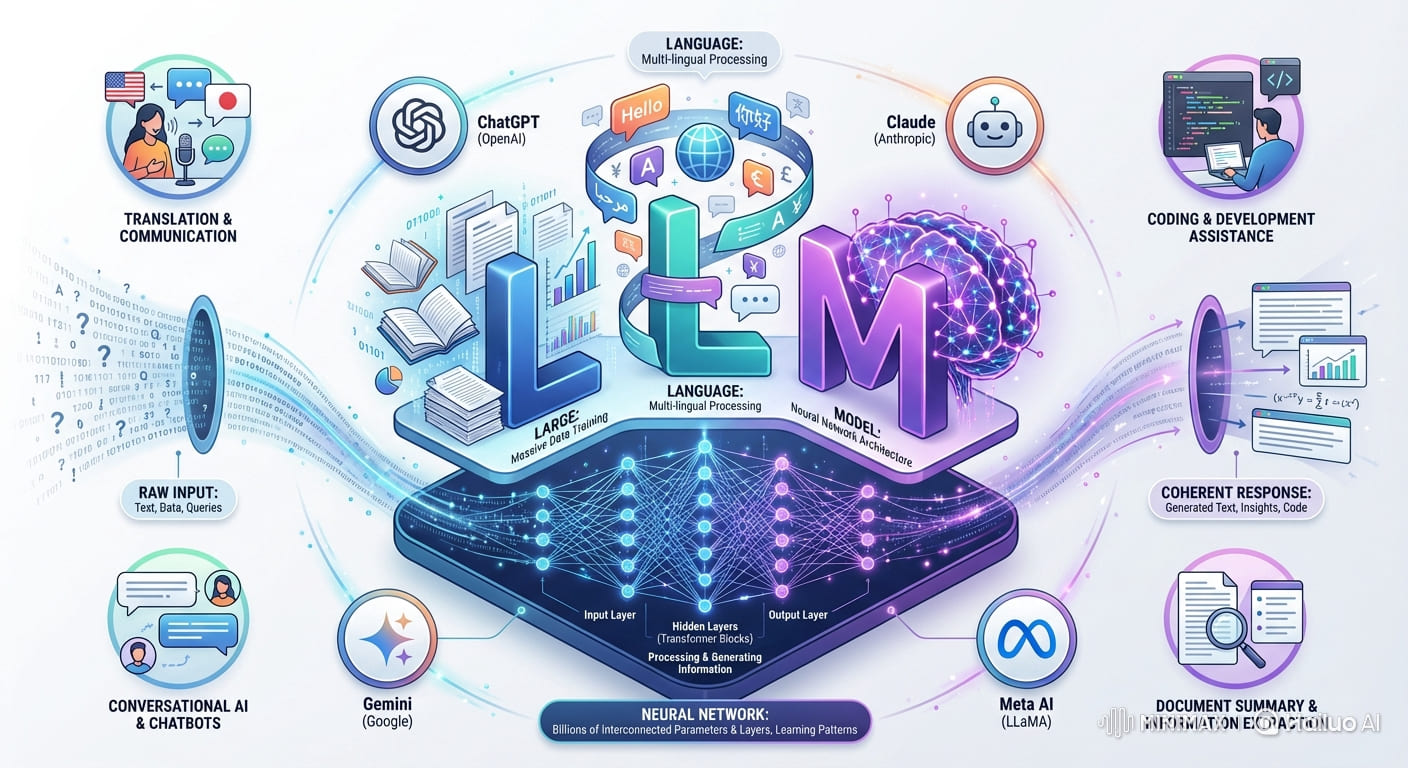
What does LLM stand for in AI? LLM stands for Large Language Model. Let's break down each word. "Large" means the model was trained on massive amounts of text data—billions of words from books, websites, and articles. "Language" means it understands and generates human language. "Model" is a mathematical representation that learned patterns from all that data.
How LLMs Work
LLMs learn by reading enormous amounts of text. They identify patterns in how words relate to each other. When you ask a question, the LLM predicts what words should come next based on everything it learned. This allows it to generate human-like responses, understand context, and maintain conversations.
Popular LLM Examples
Several well-known AI tools are powered by large language models:
- ChatGPT by OpenAI
- Claude by Anthropic
- Gemini by Google
- Llama by Meta
- GPT-4 by OpenAI
What LLMs Can Do
Large language models have impressive capabilities. They can answer questions on countless topics, write articles and stories, translate between languages, summarize long documents, write computer code, have natural conversations, and explain complex topics in simple terms.
Why "Large" Matters
The "large" in LLM is crucial. These models contain billions of parameters—the pieces that help them understand language. More data generally means better performance. Larger models understand more nuances and handle more complex tasks. However, size requires significant computing power. There's always a trade-off between size, speed, and cost.
Understanding what does llm stand for in ai matters because LLMs power the AI tools you use daily. When you chat with ChatGPT or ask Claude a question, you're interacting with a large language model. The term appears constantly in AI discussions and tech news.
What Does GPT Stand For in AI?
GPT = Generative Pre-trained Transformer
What does gpt stand for in ai? GPT stands for Generative Pre-trained Transformer. This acronym needs more explanation because each word represents an important concept.
Generative means it creates new content from scratch. GPT doesn't just retrieve stored information—it generates original responses. It produces text that never existed before by combining patterns it learned.
Pre-trained means the model learned from massive amounts of data before you ever use it. It arrives with built-in knowledge. The foundation is already built. You don't need to teach it language basics—it's ready to go immediately.
Transformer refers to the neural network architecture that powers GPT. Introduced in 2017, transformers revolutionized AI. Unlike older methods that processed words one at a time, transformers analyze all words simultaneously. This helps them understand relationships between words and context much better.
GPT Versions
GPT has evolved through several versions. GPT-1 launched in 2018 as the initial version. GPT-2 came in 2019 with improvements. GPT-3 in 2020 represented a major leap in capabilities. GPT-3.5 became the original engine behind ChatGPT. GPT-4, released in 2023, is the current advanced version. Each generation became more powerful and capable.
Why GPT Is Important
Understanding what does gpt stand for in ai is valuable because GPT powers ChatGPT, one of the most popular AI tools. It's become an industry standard architecture that many companies use. You'll see this acronym frequently in AI news and discussions. GPT represents a major breakthrough that made AI accessible to everyone. It sparked the current AI revolution and inspired competitors to develop their own models.
What Does RAG Stand For in AI?
RAG = Retrieval-Augmented Generation
What does rag stand for in ai? RAG stands for Retrieval-Augmented Generation. This is a more technical concept, but we'll make it simple.
Retrieval means searching for relevant information. The system looks through documents, databases, or websites to find specific data related to your question.
Augmented means enhanced or improved. The AI's capabilities are strengthened by adding external information. It's boosted beyond just its training data.
Generation means creating the response. After retrieving information, the system generates an answer using what it found.
How RAG Works
RAG follows a simple process. First, you ask a question. The system searches through relevant documents or databases. It finds specific, current information related to your query. Then it uses that retrieved information to generate a comprehensive answer. RAG combines retrieval and generation for better results.
Why RAG Matters
RAG provides several key benefits. It delivers up-to-date information that goes beyond the AI's training data. It can reference specific sources, making answers verifiable. RAG reduces "hallucinations"—when AI makes things up. It can access company documents and proprietary information. Overall, RAG makes AI responses more accurate and trustworthy.
RAG vs Regular AI
The difference matters. Regular AI uses only its training data, which has a knowledge cutoff date. RAG searches for current information in real-time. Regular AI is limited to what it learned during training. RAG can access the latest news, documents, and data. This makes RAG more accurate and verifiable for current information.
You'll encounter RAG in enterprise AI systems, customer support chatbots, document search tools, knowledge base assistants, and business AI applications. Many companies use RAG to make AI work with their specific data.
Other Common AI Terms and Acronyms
ML = Machine Learning
Machine Learning is a subset of artificial intelligence. ML systems learn from data without being explicitly programmed for every task. They improve with experience and identify patterns automatically. Machine learning is the foundation of most modern AI applications.
NLP = Natural Language Processing
Natural Language Processing is AI's ability to understand human language. NLP powers text analysis, language translation, sentiment analysis, and chatbots. It's what allows AI to read, understand, and respond to your words.
AGI = Artificial General Intelligence
AGI refers to AI with human-level intelligence across all tasks. It would match human capabilities in reasoning, learning, and problem-solving. AGI doesn't exist yet—it's a long-term goal. You'll see AGI discussed in future-looking AI conversations and science fiction.
Neural Networks
While not an acronym, neural networks are fundamental to AI. They're inspired by the human brain, with interconnected nodes that process information. Neural networks are the foundation of deep learning and power most modern AI systems.
Why Understanding AI Acronyms Is Important
Navigate AI Conversations
Knowing what ai stands for and related acronyms helps you understand news articles, follow tech discussions, make informed decisions, and ask better questions. You won't feel lost when people discuss AI technology. This knowledge builds confidence in professional and casual settings.
Evaluate AI Tools
Understanding ai terminology helps you compare different AI services and understand their capabilities. You'll know what you're actually using. This knowledge helps you spot marketing hype and make smart choices about which AI tools meet your needs.
Career and Learning
Tech literacy matters in today's world. AI skills are increasingly important across industries. Understanding ai acronyms provides a starting point for deeper learning. Even basic knowledge of what does ai stand for and related terms shows professional awareness.
Avoiding Confusion
The AI field is full of jargon. Acronyms appear constantly in articles and conversations. Knowing these basics prevents confusion, helps you filter information, and empowers better understanding. You can focus on content instead of getting stuck on terminology.
Easy Ways to Remember AI Acronyms
Memory Tricks
AI (Artificial Intelligence): Think "Artificial = Man-made" plus "Intelligence = Smart." It's computer brains created by humans.
LLM (Large Language Model): Think "Big Brain for Words." Large means big, Language means words, Model means the brain structure.
GPT (Generative Pre-trained Transformer): Think "Generator that's Pre-loaded and Transforms." It creates text using patterns it pre-learned.
RAG (Retrieval-Augmented Generation): Think "Retrieve, then Answer and Generate." It looks up information before responding.
Practice Using Terms
Reinforce your learning by using these acronyms in sentences. Explain them to a friend. Write down the definitions. Connect each term to examples you know from daily life. Revisit these definitions regularly until they become second nature.
Frequently Asked Questions
Is AI the same as machine learning?
No, machine learning is a subset of AI. Artificial intelligence is the broader concept. All machine learning is AI, but not all AI is machine learning. They're related but have different scopes.
Are ChatGPT and GPT the same?
ChatGPT is a product built using GPT technology. GPT is the underlying model—the engine. ChatGPT combines a chat interface with GPT capabilities. It's like the difference between a car (ChatGPT) and its engine (GPT).
Do I need to know these acronyms?
Knowing these terms is helpful but not strictly required. They make AI discussions much easier to follow. Basic knowledge improves your tech literacy. Whether you need them depends on your interests, but understanding what does ai stand for and key acronyms is increasingly valuable.
Will there be more AI acronyms?
Yes, the field evolves rapidly. New terms emerge constantly as technology advances. However, core concepts remain stable. The acronyms covered here—AI, LLM, GPT, and RAG—are the most important currently. Stay curious and keep learning as the field develops.
Understanding AI Starts With the Basics
Now you know what AI stands for—Artificial Intelligence. You understand key acronyms like LLM (Large Language Model), GPT (Generative Pre-trained Transformer), and RAG (Retrieval-Augmented Generation). These foundations help you navigate the AI landscape with confidence.
These are just the basics, but they're powerful basics. Understanding what does ai stand for and related terminology opens doors to deeper learning. You can now follow AI news, evaluate AI tools, and participate in technology conversations without confusion.
Bookmark this guide for reference when you encounter AI terms in the wild. Share it with someone who's confused by AI jargon. And most importantly, stay curious—the world of artificial intelligence is just beginning, and you now have the vocabulary to explore it.