
Why Does AI Use Water?
Data Centers Need Cooling
AI runs on powerful servers housed in data centers. These servers generate massive amounts of heat during operation. Heat damages sensitive equipment and reduces performance. Water cools these servers efficiently and reliably. Most data centers use water-based cooling systems today. Evaporative cooling is the most common method employed.How Water Cooling Works
Water absorbs heat from server systems effectively. Cooling towers then release this heat into the atmosphere. Water evaporates during this cooling process. Fresh water must be added to the system constantly. These systems run 24 hours a day, every single day. Large-scale operations consume staggering amounts of water.Why Water Over Other Methods
Water is an extremely effective coolant for servers. It's more efficient than air cooling for high-density computing. The approach is cost-effective at the massive scale required. Clean water is available in most data center locations. This has become the industry standard practice worldwide.How Much Water Does AI Use Per Prompt?
ChatGPT and Similar Tools
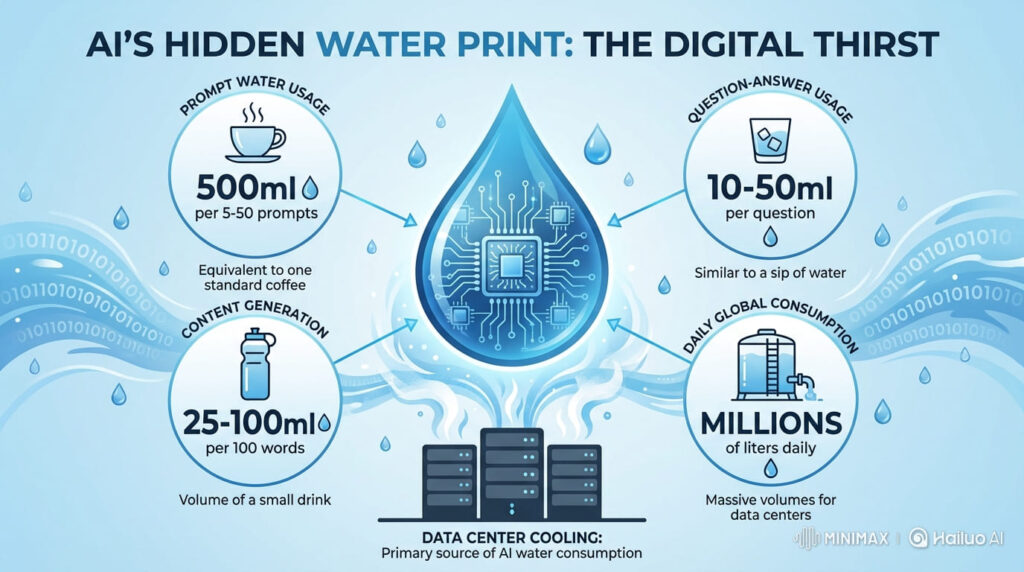
Research from the University of California, Riverside provides specific estimates. ChatGPT and similar AI systems use approximately 519 milliliters per 100-word prompt. That's roughly one standard water bottle per response. Simple queries typically use less water than complex ones. More detailed requests require more processing power. The size of the AI model significantly affects consumption. The variation exists because prompts differ in complexity. Short, simple questions process faster and use fewer resources. Long conversations with context require more computational power. Each additional interaction adds to the total water footprint.How Much Water Does AI Use Per Question?
An average single query uses an estimated 10-50ml of water. Short, straightforward questions fall at the lower end. Complex conversations requiring extensive processing use more. The context window size impacts water consumption significantly. Multi-turn dialogues accumulate usage quickly across exchanges. OpenAI CEO Sam Altman stated that an average ChatGPT query uses roughly one-fifteenth of a teaspoon of water, though the exact parameters of "average" remain unclear. This translates to approximately 10ml per query. However, this figure might not include training costs. Think of it as similar to a small sip of water. But this amount gets multiplied millions of times daily. The scale transforms small numbers into huge environmental impact.How Much Water Does AI Use Per 100 Words?
Generating text is particularly resource-intensive. Each 100-word AI response consumes approximately 519 milliliters of water based on current research. Longer outputs require proportionally more processing resources. Token generation correlates directly to server computational time. More server time means more cooling water consumed. This matters significantly for various use cases. Long-form AI content creation has substantial water costs. Article generation uses considerably more water than short answers. Code generation also contributes to consumption. Every creative writing task adds to the footprint.How Much Water Does AI Use Per Day?
Global scale numbers reveal the true magnitude. ChatGPT alone uses around 148 million liters (39 million gallons) daily according to recent estimates. All AI services combined consume billions of liters worldwide. Major tech companies operate hundreds of data centers globally. These consumption trends continue growing rapidly with AI adoption. To put this in perspective, this daily usage could fill thousands of Olympic-sized swimming pools annually. It exceeds the daily water consumption of entire small towns. This is equivalent to everyone in Taiwan flushing their toilet at once. These visualizations help grasp the enormous scale involved.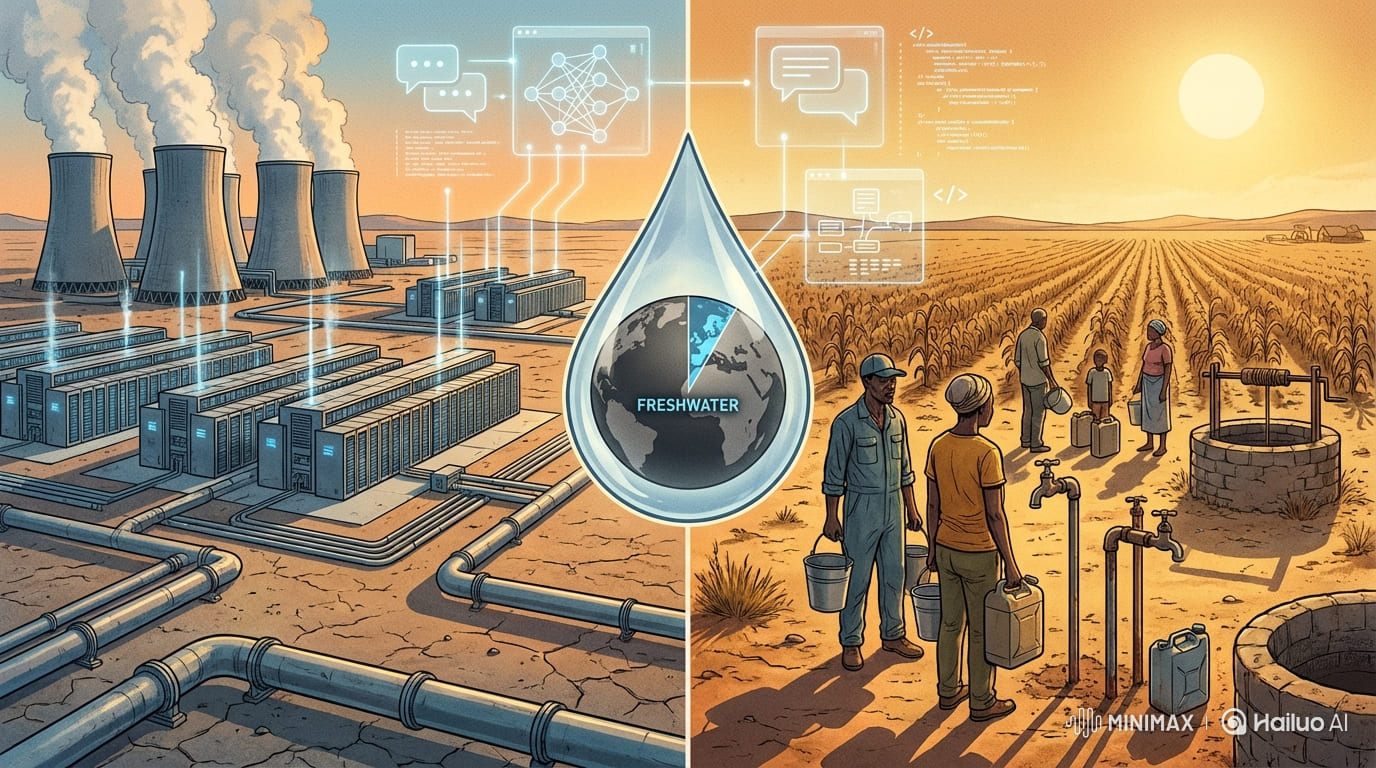
The Environmental Impact of AI Water Usage
Freshwater Is Limited
Only 3% of Earth's water is freshwater, and only 0.5% is accessible for human consumption. Water scarcity currently affects billions of people worldwide. The tech industry increasingly competes with local communities for water. Drought-prone regions face mounting conflicts over water rights. Climate change continues worsening these challenging situations.Where Does This Water Go?
Much of the water used evaporates permanently during cooling. It doesn't return to local water systems immediately. Water is lost to the atmosphere through evaporation. It cannot be reused right away by communities. This process depletes local water tables in affected areas.Data Center Locations
Two-thirds of new data centers built since 2022 are located in water-stressed regions. Proximity to reliable power sources influences location decisions. Climate considerations affect cooling requirements and efficiency. Communities experience direct impacts on their water availability. Water rights conflicts emerge in many affected areas.Growing AI Demand
AI usage is increasing exponentially across all sectors. More powerful models are being developed continuously. Larger models inherently need more computational resources. ChatGPT, Gemini, Claude, and others all contribute significantly. The cumulative effect across all systems is massive.How AI Water Usage Compares
AI vs Other Activities
AI queries consume significantly more resources than traditional computing. An AI search uses 5-10 times more water than a standard Google search. Streaming video for one minute is comparable to an AI query. AI uses substantially more than sending a simple email. Social media browsing has a much lower water impact overall.Training vs Inference
Training AI models requires enormous amounts of water upfront. Training large language models like GPT-3 can consume millions of liters of fresh water. Daily usage for answering queries (inference) remains significant but lower. Training represents a one-time massive cost per model. Inference creates an ongoing, accumulating cost as usage grows.Different AI Models
Larger AI models consistently use more water than smaller ones. GPT-4 uses more resources than its predecessor GPT-3.5. Image generation AI systems also consume substantial water. Video generation AI requires even more computational power. Specialized models vary widely in their resource demands.Tech Giants and Water Consumption
Major Players
Microsoft operates extensive Azure data centers globally. These facilities power ChatGPT's backend infrastructure. Google's hyperscale data centers averaged approximately 550,000 gallons (2.1 million liters) of water daily recently. Google also runs Gemini AI services worldwide. Meta operates AI research facilities and standard data centers. Amazon's AWS cloud services host numerous AI models. Each company maintains a large water footprint.Transparency Issues
Only 51% of data center operators track their water usage, and only 10% monitor usage across all facilities. Most available figures are self-reported by companies. Independent verification of these numbers proves difficult. Greater accountability and disclosure are urgently needed.Reducing AI's Water Footprint
Current Solutions
Some facilities are switching to air cooling systems. This approach is less water-intensive for operations. Air cooling works particularly well in cooler climates. However, it often comes with higher energy costs. Using recycled or non-potable water reduces freshwater demand. Wastewater treatment enables reuse for cooling purposes. Implementation faces technical and regulatory challenges. This practice is growing but not yet universal. Advanced cooling technologies improve overall efficiency significantly. Heat recovery systems capture waste heat for other uses. Optimized facility designs reduce overall cooling needs. Smart temperature management systems minimize water consumption.Future Technologies
Liquid cooling innovations show great promise for efficiency. Immersion cooling submerges servers directly in coolant. More efficient computer chips reduce power and cooling needs. Lower overall power consumption means less heat generation. Renewable cooling methods are being actively researched.What Users Can Do
Use AI tools thoughtfully rather than automatically. Avoid making unnecessary or redundant queries when possible. Support companies committed to sustainable AI practices. Advocate for greater transparency in environmental reporting. Choose efficient AI models when alternatives exist.AI, Water, and Our Future
Balancing Progress and Sustainability
AI delivers undeniable benefits to society and productivity. However, environmental costs demand serious consideration and action. Innovation in efficiency technology must accelerate quickly. Tech companies bear primary responsibility for sustainable practices. User awareness plays an important role in driving change.Regulation and Accountability
Calls for disclosure laws are growing louder globally. Water usage reporting requirements are being proposed. Environmental standards for data centers need strengthening. Industry self-regulation has proven insufficient so far. Government involvement may become necessary for real progress.Your Role
Stay informed about AI's environmental impact regularly. Ask questions about the tools and services you use. Support technology companies prioritizing sustainability publicly. Demand transparency from AI developers and providers. Make conscious choices about when AI is truly necessary.Understanding AI's Water Cost
How much water does AI use? The numbers are substantial and growing. A single 100-word response consumes about 519ml of water. ChatGPT alone uses 148 million liters daily worldwide. AI water consumption rivals entire cities' daily usage. Growing awareness is driving conversations about sustainable AI development. Hope exists through emerging technologies and responsible practices. Understanding these impacts empowers better choices for everyone. Now that you know how much water AI uses, consider your own usage patterns. Share your thoughts on AI's environmental impact in the comments below. Together, we can advocate for more sustainable AI development. Every informed choice contributes to a more responsible tech future.Frequently Asked Questions
Does ChatGPT really use water?
Yes, ChatGPT uses water indirectly through data center cooling systems. The servers processing your queries generate heat that must be cooled using water-based systems. Each query contributes to overall water consumption, with estimates suggesting ChatGPT consumes approximately 148 million liters daily worldwide.
Why does AI need water to operate?
AI doesn't directly use water, but the powerful servers running AI models generate massive heat. Data centers use water-based cooling systems, primarily evaporative cooling, to prevent equipment damage. Water efficiently absorbs and dissipates heat, making it the industry standard for cooling high-density computing operations.
How much water does one AI query consume?
A single AI query uses approximately 10-50ml of water depending on complexity. Simple questions use less, while detailed conversations require more processing power. For context, generating 100 words of AI text consumes about 519ml of water, roughly equivalent to one standard water bottle.
Which uses more water: AI or Google search?
AI searches consume significantly more water than traditional Google searches. An AI query uses approximately 5-10 times more water than a standard search. This difference exists because AI requires intensive computational processing and larger server resources, resulting in more heat generation that needs water cooling.
Can AI become more water-efficient in the future?
Yes, several promising solutions exist. Companies are developing advanced air cooling systems, immersion cooling technology, and more efficient computer chips. Using recycled water, optimizing data center designs, and implementing heat recovery systems can significantly reduce AI water consumption. Innovation continues accelerating in sustainable AI development.