

Here's a sobering statistic: The vast majority of small business owners have no clear idea what their company is truly worth. They've poured years of effort into building something valuable, yet when it comes time to sell, they're flying blind—either leaving substantial money on the table or pricing themselves out of the market entirely.
Understanding how to price a business for sale isn't just about picking a number that "feels right." It's about securing fair compensation for your years of hard work while presenting a valuation that stands up to buyer scrutiny. Get it wrong, and you could watch potential buyers walk away, or worse, accept an offer far below what your business deserves.
The stakes extend beyond the sale price itself. Proper valuation affects negotiations, determines tax obligations, and ensures legal compliance in situations ranging from estate planning to divorce proceedings. In 2025's market, where buyers increasingly focus on stable earnings rather than growth hype, arriving at the right price requires both precision and market awareness.
This comprehensive guide walks you through five proven valuation methods that professional business appraisers and M&A advisors use: Seller's Discretionary Earnings (SDE), EBITDA multiples, revenue multiples, Discounted Cash Flow (DCF) analysis, and asset-based valuation. Each method serves different business types and situations, and understanding when to use each one can mean the difference between a successful exit and a failed sale.
"Determining the correct value for your business sale isn't just about numbers—it's about securing fair compensation for years of hard work."
Let's start with why business valuation matters so much in the first place.
Why Business Valuation Matters
Proper business valuation isn't academic exercise—it's a critical foundation for a successful sale that protects your interests and builds buyer confidence.
Ensures Fair Compensation
The most obvious reason to get valuation right is financial. Price too low, and you leave potentially hundreds of thousands of dollars on the table. Price too high, and serious buyers won't even schedule a meeting. A properly valued business gives you negotiation confidence backed by defensible methodology. When a buyer questions your asking price, you can point to multiple valuation approaches that support your number rather than relying on gut feeling.
Legal and Tax Compliance
Business valuations aren't just for sales. The IRS requires proper valuations for estate planning, gift tax calculations, and charitable contributions. During divorce proceedings, courts demand professional appraisals to ensure equitable asset division. Larger companies face SEC filing requirements that necessitate formal valuations. Using arbitrary or inflated values in these situations can trigger audits, penalties, or legal disputes that cost far more than hiring a professional appraiser in the first place.
Reveals Hidden Value
Many business owners undervalue their companies because they focus solely on revenue or profit while overlooking intangible assets. Brand equity built over years, loyal customer relationships that generate recurring revenue, proprietary intellectual property, trained workforces, and established vendor relationships all add value beyond what appears on financial statements. A systematic valuation process identifies these value drivers and ensures they're properly reflected in your asking price.
Minimizes Transaction Risk
Clean, professional valuations accelerate the sales process. When you present buyers with audit-ready documentation supporting your asking price, you build confidence from the first conversation. Buyers can move through due diligence faster when financials are organized and valuation methodology is transparent. This reduces the likelihood that deals fall apart during the negotiation phase due to unexpected discoveries or valuation disputes.
"The most successful business sales combine multiple valuation approaches with clean financial documentation."
Understanding why valuation matters sets the stage for the preparation work ahead.
Preparing for Valuation: 4 Essential Steps
Before diving into valuation methodologies, you need to organize the information that feeds into them. Skipping this preparation almost guarantees an inaccurate valuation.
Step 1: Organize Financial Documentation
Professional buyers and valuation experts won't trust incomplete records. You need clear, consistent financial statements covering at least the past three years, though five years is better for establishing trends.
Essential documents include:
- Profit and loss statements showing revenue, expenses, and net income
- Balance sheets detailing assets, liabilities, and equity
- Tax returns that verify reported income
- Cash flow statements demonstrating actual cash generated
- Accounts receivable and payable aging reports showing collection patterns
These documents need to reconcile. If your tax returns show different numbers than your P&L statements, buyers will assume the worst. Clean this up before starting the valuation process.
Step 2: Inventory Your Assets
Business value includes both tangible and intangible assets, and overlooking either category leaves money on the table.
Tangible assets are straightforward: equipment and machinery, real estate and property, inventory at current market value, vehicles and tools. These items have clear market values that can be verified through comparable sales or professional appraisals.
Intangible assets require more thought but often represent significant value: brand reputation and recognition in your market, customer relationships and loyalty programs, intellectual property like patents and trademarks, proprietary processes or technology that give you competitive advantages, trained workforces that can continue operations without you, and established vendor relationships with favorable terms.
Document everything. Create a comprehensive asset list with current market values for tangibles and detailed descriptions for intangibles.
Step 3: Calculate Key Financial Metrics
Buyers evaluate businesses using standardized metrics that allow apples-to-apples comparisons. Calculate these before starting your valuation:
Seller's Discretionary Earnings (SDE) shows the total financial benefit to an owner-operator. The formula: SDE = Net Income + Owner's Salary + Benefits + Non-Essential Expenses + Interest + Taxes + Depreciation + Amortization.
EBITDA (Earnings Before Interest, Taxes, Depreciation, and Amortization) removes owner-specific factors to show operating profit: EBITDA = Net Income + Interest + Taxes + Depreciation + Amortization.
Additional metrics that buyers examine include revenue growth rate over multiple years, profit margins (gross and net), customer acquisition cost, customer lifetime value, and recurring revenue percentage.
These calculations reveal trends. A business with 30% year-over-year growth commands different multiples than one with flat or declining revenue.
Step 4: Understand Market Factors
External factors significantly impact how much buyers will pay. Consider these influences on your business value:
Industry trends matter tremendously. Is your sector growing or contracting? Are new technologies disrupting traditional business models? Buyers pay premiums for businesses in growth industries and discount those facing headwinds.
Economic conditions affect buyer sentiment and financing availability. Higher interest rates in 2025 have compressed multiples across most sectors as borrowing becomes more expensive.
Competitive landscape determines defensibility. If competitors can easily replicate your business model, expect lower multiples. Unique positioning or high barriers to entry command premiums.
Customer concentration creates risk. If one customer represents more than 10% of revenue, buyers will discount the valuation to account for this vulnerability.
Owner dependency reduces value. Businesses that cannot function without the current owner sell for less because buyers face operational risk post-acquisition.
Understanding these preparation steps sets you up for accurate valuation using the five core methods we'll explore next.
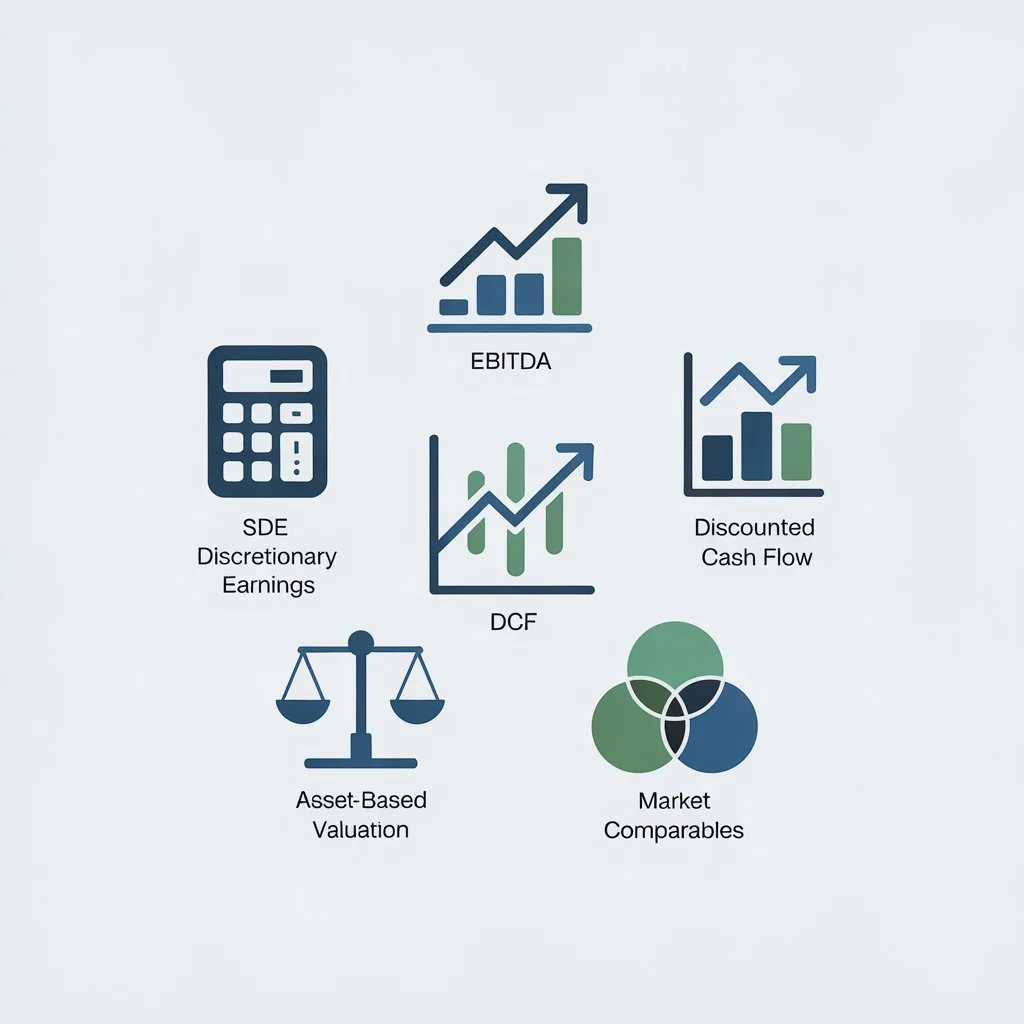
METHOD 1: Seller's Discretionary Earnings (SDE) - Most Common for Small Businesses
Seller's Discretionary Earnings valuation is the go-to method for small businesses, particularly those with EBITDA under $1 million. It's designed specifically for owner-operated companies where the owner's compensation and personal expenses run through the business.
What It Is
SDE represents the total financial benefit to a single owner-operator. Unlike EBITDA, which strips out all ownership-specific items, SDE adds back the owner's salary, benefits, and discretionary expenses to show what a new owner could potentially take home. This makes it particularly relevant for small business buyers who plan to actively operate the company themselves.
How It Works
The SDE calculation follows these steps:
- Start with net income from your profit and loss statement
- Add back the owner's salary and benefits
- Add back personal expenses run through the business (vehicle, travel, meals, etc.)
- Add back interest, taxes, depreciation, and amortization
- The result is your SDE
- Multiply SDE by the appropriate industry multiple to estimate business value
Industry multiples for SDE typically range from 1.5x to 4x, varying by sector, growth rate, and business characteristics.
Real-World Example
Consider a digital marketing agency with $400,000 in annual revenue:
- Net income: $80,000
- Owner salary: $60,000
- Personal expenses: $10,000
- Interest, taxes, depreciation, amortization: $15,000
- SDE = $165,000
Research from industry analysts shows that service businesses in the Main Street market typically command multiples of 3.3x to 4.0x for deals with $1M-$2M SDE. For this agency, applying a 2.5x multiple (conservative for an agency without long-term contracts):
Business value = $165,000 × 2.5 = $412,500
Best For
SDE valuation works best for:
- Small businesses under $1M EBITDA
- Owner-operated companies where the owner actively works in the business
- Service businesses with limited physical assets
- Single-location operations
- Businesses targeting individual buyers rather than institutions
"The SDE method gets to the heart of what matters most, showing potential buyers exactly what they can take home from the business."
The SDE approach dominates small business sales because it directly answers the buyer's core question: "What will this business put in my pocket?"
METHOD 2: EBITDA Multiple - For Mid-Market Businesses
Once businesses exceed $1 million in EBITDA, the standard shifts from SDE to EBITDA multiples. This method removes owner-specific factors and evaluates the business as a standalone enterprise.
What It Is
EBITDA multiple valuation calculates enterprise value by multiplying earnings before interest, taxes, depreciation, and amortization by an industry-specific multiple. Unlike SDE, this approach doesn't add back owner salary because mid-market buyers typically install professional management rather than operating the business themselves.
How It Works
The process is straightforward:
- Calculate EBITDA (operating profit before interest, taxes, depreciation, amortization)
- Research industry-specific multiples for businesses of your size
- Adjust the multiple based on your specific characteristics
- Multiply adjusted EBITDA by the multiple
Adjustments to base multiples consider growth rate (higher growth commands premium multiples), customer concentration (lower concentration increases multiples), competitive advantages and barriers to entry, market position and brand strength, and recurring revenue percentage.
Industry Multiple Ranges (2025)
Current data shows significant variation in EBITDA multiples across sectors. Here are representative ranges:
- Tech/SaaS: 5x-8x+ (high growth potential and recurring revenue)
- Manufacturing: 3x-6x (capital intensive, moderate growth)
- Professional services: 3x-5x (people-dependent, lower asset value)
- Retail: 2x-4x (thin margins, competitive pressure)
- Restaurants: 1.5x-3x (high labor costs, location dependency)
Small businesses typically see lower multiples, generally in the range of 4x EBITDA, while larger public companies command higher valuations.
Real-World Example
A SaaS company with $2M EBITDA:
- Base industry multiple: 6x (tech sector)
- Growth adjustment: +0.5x (40% year-over-year growth)
- Adjusted multiple: 6.5x
- Business value = $2M × 6.5 = $13M
This same company using lower multiples typical of slower-growth businesses would be valued at $10-12M instead, showing how growth rates significantly impact final valuation.
Best For
EBITDA multiple valuation is appropriate for:
- Mid-market companies with $1M-$50M revenue
- Businesses attracting institutional buyers (private equity, strategic acquirers)
- Companies with professional management teams already in place
- Growth-stage companies with scalable operations
- Businesses where owner dependency has been minimized
The shift from SDE to EBITDA multiples reflects a fundamental change in buyer profile—from individual operators to institutional investors evaluating the business as a standalone asset.
METHOD 3: Revenue Multiple - For High-Growth or Asset-Light Businesses
Revenue multiples offer a quick valuation method particularly relevant for high-growth companies, businesses with negative EBITDA, and asset-light digital operations where traditional profit-based approaches don't capture value.
What It Is
Revenue multiple valuation values a business as a multiple of annual revenue rather than profit. This approach dominates in industries where profit margins are standardized or where growth potential matters more than current profitability. It's also the default method for pre-profitable companies with strong revenue traction.
How It Works
The calculation is simple:
- Calculate annual revenue (typically last 12 months or next 12 months projected)
- Apply industry-specific revenue multiple
- Adjust for factors like growth rate, recurring revenue percentage, and customer retention
Revenue multiples vary dramatically by industry, making research into comparable company sales essential.
Typical Revenue Multiples
Industry benchmarks for 2025:
- SaaS with 80%+ recurring revenue: 3x-10x revenue (higher end for companies with strong growth and low churn)
- E-commerce: 0.5x-2x revenue (lower margins, competitive pressure)
- Digital agencies: 0.5x-1.5x revenue (project-based work commands lower multiples)
- Content businesses: 2x-4x revenue (recurring traffic, ad revenue, or subscriptions)
Companies displaying 10x or higher revenue multiples represent the highest chances of growth, profits, and expansion according to investor perspectives.
Real-World Example
E-commerce store with $800,000 annual revenue:
- Industry standard: 1.5x revenue
- Adjustment for 50% repeat customer rate: +0.3x
- Adjusted multiple: 1.8x
- Business value = $800,000 × 1.8 = $1,440,000
A similar e-commerce business with only 20% repeat customers might apply a 1.2x multiple instead, resulting in a $960,000 valuation—a $480,000 difference based on customer loyalty alone.
Best For
Revenue multiple valuation makes sense for:
- Pre-profitable growth companies with strong unit economics
- SaaS and subscription businesses with recurring revenue models
- Asset-light digital businesses (content sites, online marketplaces)
- Companies with negative EBITDA but clear paths to profitability
- Industries where revenue multiples are standard practice
Important Warning
"A company doing $500K sales with $100K profit is worth a multiple of that $100K profit—not $500K sales."
Many entrepreneurs make the mistake of applying revenue multiples to profitable businesses where profit multiples would be more appropriate. This typically results in undervaluation. Use revenue multiples primarily when profit multiples don't apply (negative earnings) or when industry standards dictate (SaaS, subscription businesses).
METHOD 4: Discounted Cash Flow (DCF) - For Predictable Cash Flows
Discounted Cash Flow analysis is considered the "gold standard" of business valuation by financial professionals. While more complex than other methods, DCF provides the most theoretically sound valuation by calculating the present value of future cash flows.
What It Is
DCF valuation projects a business's future free cash flows over a specific period (typically 5-10 years), then discounts those future cash flows back to present value using a discount rate that reflects the investment's risk. The method also calculates a "terminal value" representing the business's worth beyond the projection period.
How It Works
DCF analysis follows these steps:
- Project free cash flow for the next 5-10 years based on historical performance and growth assumptions
- Determine an appropriate discount rate (typically 10-25% based on business risk)
- Calculate terminal value using either the perpetuity growth method or exit multiple method
- Discount all future cash flows and terminal value to present day
- Sum discounted values to get total enterprise value
The formula: PV = CF₁/(1+r)¹ + CF₂/(1+r)² + ... + CFₙ/(1+r)ⁿ + Terminal Value/(1+r)ⁿ
Where:
- PV = Present Value
- CF = Cash Flow for each year
- r = Discount rate
- n = Number of years
Real-World Example
Manufacturing company projecting steady cash flow:
- Year 1-5 cash flows: $500K, $550K, $600K, $650K, $700K
- Discount rate: 15% (reflects industry and execution risk)
- Terminal value: $700K / 0.15 = $4.67M (perpetuity growth method)
- Present value of Year 1-5 cash flows: $2.01M
- Present value of terminal value: $1.79M
- Business value = $3.8M
The discount rate significantly impacts valuation. Using 20% instead of 15% would reduce this company's value to approximately $3.2M, showing how risk assessment directly affects DCF outcomes.
Best For
DCF valuation is appropriate for:
- Stable, predictable businesses with consistent historical cash flow
- Companies with 5+ years of operating history
- Larger businesses ($5M+ revenue) where detailed projections are feasible
- Situations requiring formal valuation reports (litigation, tax purposes, estate planning)
- Businesses seeking strategic buyers who will perform detailed financial analysis
DCF's complexity makes it less common for small business sales but increasingly standard as deal size increases. Professional M&A advisors and investment bankers typically build DCF models for transactions exceeding $5-10 million.
METHOD 5: Asset-Based Valuation - For Asset-Heavy Businesses
Asset-based valuation takes a fundamentally different approach by valuing a business based on its tangible and intangible assets minus liabilities. This method is most appropriate for asset-heavy industries and often serves as a "floor" value—the minimum a business should sell for.
What It Is
Asset-based valuation calculates business worth by adding up all assets (at fair market value) and subtracting liabilities. Three variations exist: book value method (uses balance sheet values), adjusted net asset value (revalues assets at current market prices), and liquidation value (assumes quick sale of assets, typically 40-60% of book value).
How It Works
Book Value Method is the simplest approach:
- Start with total assets from the balance sheet
- Subtract total liabilities
- Result equals book value or net worth
However, book value often undervalues businesses because assets depreciate on paper while appreciating in real markets.
Adjusted Net Asset Value provides more accuracy:
- Inventory all tangible assets (equipment, real estate, inventory, vehicles)
- Determine fair market value for each asset
- Add intangible assets (brand value, customer lists, intellectual property)
- Subtract liabilities at current value
- Result equals adjusted net worth
Liquidation Value establishes the floor:
- Determine quick-sale value for all assets (typically 40-60% of fair market value)
- Subtract liabilities
- Result shows minimum value in distressed sale
Real-World Example
Construction company asset valuation:
Assets at fair market value:
- Equipment: $800,000 (excavators, trucks, tools)
- Real estate: $1,200,000 (yard and office building)
- Inventory: $150,000 (materials on hand)
- Brand value: $100,000 (established reputation, customer relationships)
- Total assets: $2,250,000
Liabilities:
- Equipment loans: $300,000
- Mortgage: $200,000
- Trade payables: $100,000
- Total liabilities: $600,000
Business value = $2,250,000 - $600,000 = $1,650,000
This establishes a floor. If profit-based methods value the business higher (which they typically should for an operating company), you'd use the higher figure. But knowing the asset-based value ensures you never sell for less than the liquidation value.
Best For
Asset-based valuation makes sense for:
- Asset-heavy industries (manufacturing, construction, real estate-intensive businesses)
- Companies with significant tangible assets relative to earnings
- Distressed businesses or liquidation scenarios
- Establishing a minimum valuation floor
- Businesses where earnings don't reflect asset value (turnaround situations)
Asset-based approaches rarely represent the full value of a profitable operating business but serve as an important reality check against other valuation methods.
Choosing the Right Method
With five different valuation approaches available, how do you know which to use? The answer depends on your business type, size, profitability, and target buyer.
Decision Framework
Use SDE if:
- Annual EBITDA under $1M
- You operate the business day-to-day
- Targeting individual buyers or small investors
- Service-based company with limited physical assets
- Owner salary represents significant portion of profit
Use EBITDA Multiple if:
- EBITDA over $1M annually
- Professional management team exists or can be installed
- Targeting institutional buyers (private equity, strategic acquirers)
- Established, stable business with consistent earnings
- Want to compare directly to industry benchmarks
Use Revenue Multiple if:
- High-growth company with negative or minimal EBITDA
- SaaS or subscription model with strong recurring revenue
- Industry standard is revenue-based pricing
- Strong unit economics despite current losses
- Buyers focused on growth potential over current profit
Use DCF if:
- Predictable, stable cash flows over multiple years
- Long operating history demonstrates consistency
- Sophisticated buyer will conduct detailed financial analysis
- Formal valuation report required (legal, tax, estate purposes)
- Strategic acquisition where synergies matter
Use Asset-Based if:
- Significant tangible assets relative to earnings
- Real estate or equipment-intensive industry
- Establishing valuation floor
- Distressed situation or turnaround opportunity
- Earnings don't reflect underlying asset value
Pro Tip: Triangulation
"Use multiple methods and triangulate. If one method values your business at $180,000 and another at $400,000, investigate why. Average them or weight toward the most appropriate method for your industry."
The best approach is using 2-3 methods that make sense for your business, then comparing results. If valuations cluster around a similar number, you have confidence. If they diverge significantly, understand why before settling on an asking price. Perhaps the SDE method shows $500K but asset-based shows $800K because you own valuable real estate—this suggests your asking price should be closer to $800K with the property included.
Adjusting Your Valuation
Base valuation methods provide a starting point, but numerous factors can increase or decrease your business's final value. Understanding these adjustments helps you price appropriately and explains valuation differences between similar businesses.
Factors That Increase Value
Recurring revenue commands 10-30% premiums. Subscription models, maintenance contracts, and retainer relationships reduce buyer risk and increase predictability.
Diversified customer base adds value. When no single customer represents more than 10% of revenue, businesses typically sell for higher multiples because customer loss risk is distributed.
Professional management team in place means the business can operate without the owner. This dramatically expands the buyer pool and justifies premium pricing.
Proprietary technology or intellectual property creates defensible competitive advantages that justify higher valuations, particularly if protected by patents or trademarks.
Strong brand recognition built over years has real value. Companies with established reputations can charge premium prices and attract customers more easily than unknowns.
Multiple growth channels demonstrate that the business isn't dependent on a single marketing or sales approach. Diversification reduces risk.
Clean financials and systems accelerate due diligence and build buyer confidence from first contact. Well-documented processes show professional operation.
Long-term contracts with customers or favorable supplier agreements transfer value to the new owner and reduce uncertainty.
Owner transition plan included eases buyer concerns about maintaining operations post-acquisition.
Factors That Decrease Value
Customer concentration is a major red flag. If one customer represents more than 25% of revenue, expect significant valuation discounts (often 20-40%).
Owner dependency for operations, sales, or key relationships means the business might struggle post-sale. Buyers heavily discount businesses that can't function without the current owner.
Declining industry trends create headwinds for future growth, depressing current valuations even if current earnings are strong.
Pending litigation or regulatory issues introduce uncertainty and risk. Buyers will discount valuations or walk away entirely until these are resolved.
Poor financial records destroy buyer confidence and make due diligence difficult or impossible. Disorganized books can cut valuations by 30% or more.
Outdated technology or equipment requires buyer investment immediately post-acquisition, reducing what they'll pay upfront.
Short lease terms create relocation risk, particularly for retail or restaurant businesses where location drives revenue.
High employee turnover suggests cultural or compensation issues that will persist under new ownership.
Seasonal revenue fluctuations increase working capital requirements and business risk, depressing valuations.
2025 Market Conditions
Current market data shows transaction volume increasing in Q3 2025, with closed deals up 8% year-over-year, though median sale prices have softened slightly. Key trends affecting valuations:
"Valuations in 2025 emphasize stable earnings over hype. Buyers focus on current cash flow and achievable near-term growth."
Higher interest rates remain a significant barrier for deals, though expected Federal Reserve rate cuts later in 2025 could stimulate acquisitions. Buyers are demonstrating strong interest in essential service businesses while being more cautious about capital-intensive manufacturing operations.
Quality businesses with clean books and realistic growth projections still command strong multiples. The key is demonstrating stability and defensibility rather than relying on ambitious projections.
Common Valuation Mistakes
Even experienced business owners make critical errors when valuing their companies. Avoiding these pitfalls can mean the difference between a successful sale and a listing that languishes for months.
Mistake #1: Confusing Revenue with Profit
"Buyers pay for profit, not sales."
This is perhaps the most common error. A business generating $500,000 in revenue with $100,000 profit is worth a multiple of that $100,000 profit—not $500,000 in sales. Don't focus exclusively on top-line growth while ignoring profitability. A company with $1M revenue and $200K profit is worth far more than one with $2M revenue and $100K profit.
Mistake #2: Banking on Future Potential
"Buyers won't pay today for results you haven't delivered."
Entrepreneurs naturally see their business's potential. They know exactly what could be achieved with more investment, better marketing, or product expansion. But buyers heavily discount projections that haven't been proven. If you claim the business could double revenue with minimal investment, buyers wonder why you haven't done it yourself. Focus on demonstrated performance, not hypothetical future results.
Mistake #3: Emotional Pricing
"Your years of effort don't translate to business value."
It's natural to feel attached to a business you've built from scratch. The long hours, personal sacrifices, and emotional investment feel like they should count toward valuation. They don't. Buyers evaluate financial performance, market position, and growth potential—not your personal journey. Let data drive the number, not sentiment.
Mistake #4: Using Wrong Method
Don't apply revenue multiples to profitable service businesses that should use EBITDA or SDE methods. Don't use SDE methodology for $10M companies where EBITDA multiples are standard. Match the valuation method to your business type and size, or you'll end up with meaningless numbers that buyers won't take seriously.
Mistake #5: Ignoring Intangibles
Brand value, customer relationships, proprietary processes, and intellectual property add significant value but won't show up in basic financial calculations. Document these intangible assets and quantify their impact on business performance. A company with 80% customer retention is worth more than one with 30% retention even if current revenue is identical.
Mistake #6: Poor Financial Documentation
Incomplete or disorganized records destroy credibility instantly. When personal and business expenses are mixed, buyers assume you're hiding something. When financial statements don't reconcile with tax returns, buyers walk away. Invest in clean, professional accounting before starting the valuation process. The cost is minimal compared to the price reduction from presenting messy books.
Mistake #7: DIY Without Professional Input
Online calculators provide rough estimates useful for initial planning, but complex businesses need certified appraisers. A professional valuation costs $2,000-$10,000 depending on business complexity, but the investment typically pays for itself through higher sale prices, faster closings, and reduced negotiation friction. Research indicates that businesses prepared 18-24 months ahead of sale command 20-40% higher prices.
When to Hire a Professional
Understanding when DIY valuation is sufficient versus when professional help is required prevents both wasted money and costly mistakes.
DIY Valuation Appropriate When:
- You're in the initial exploration stage, just testing whether selling makes sense
- You need a ballpark estimate for internal planning purposes
- Your business is simple and small (under $500K value)
- You're considering options informally without immediate sale plans
Free online calculators and the methods outlined in this guide can provide reasonable estimates for these situations.
Professional Appraisal Required For:
- Actual sale negotiations with serious buyers
- IRS estate or gift tax matters where accuracy is legally required
- Divorce proceedings requiring court-approved valuations
- Partner buyouts where fairness to all parties matters
- Loan applications where lenders require formal appraisals
- Litigation or legal disputes involving business value
- SBA financing where lender standards demand professional valuation
In these situations, informal estimates won't suffice. You need certified professionals whose credentials and methodology will withstand scrutiny.
Types of Professionals
Certified Business Appraisers:
- Credentials: ASA (Accredited Senior Appraiser), CVA (Certified Valuation Analyst), ABV (Accredited in Business Valuation)
- Cost: $5,000-$15,000+ depending on business complexity
- Provides IRS-compliant formal appraisal reports
Business Brokers:
- Help with valuation AND manage the entire sale process
- Commission: 8-12% of sale price for businesses under $1M, with most brokers charging 10%
- Best for businesses under $5M in value, with minimum fees typically $10,000-$15,000
M&A Advisors:
- For mid-market and larger deals ($2M-$50M)
- Comprehensive transaction support including valuation, buyer identification, and negotiation
- Fee structure: 2-5% of sale price or monthly retainer plus success fee
- Often use Double Lehman formula: 10% on first $1M, 8% on second $1M, 6% on third, 4% on fourth, 2% on fifth
Investment Bankers:
- For large transactions ($10M+)
- Full-service advisory including complex deal structures
- Fees typically 1-4% for larger deals
Online Valuation Tools
- BizBuySell calculator: Free, provides basic estimates
- BizEquity: $99-$500 for more detailed reports
- Equidam: Industry-specific multiple data
These tools are useful for initial estimates only. Don't rely on them for actual sale negotiations or legal/tax purposes.
ROI of Professional Valuation
Professional valuations typically deliver:
- 15-25% higher sale prices through better positioning and negotiation
- Faster closings due to superior documentation and preparation
- Reduced negotiation friction when buyers see credible supporting data
- Tax optimization opportunities that can save thousands
- Audit-ready documentation that prevents regulatory issues
The upfront cost of professional help is almost always recovered through better outcomes.
Maximizing Your Business Value Before Sale
The best time to start preparing for a sale is 18-24 months before you plan to list. This preparation period can increase your sale price by 20-40% compared to selling unprepared.
12-24 Month Pre-Sale Strategy
Financial Optimization:
Clean up accounting and completely separate personal from business expenses. Buyers lose confidence when they can't tell what expenses are truly business-related. Document all revenue streams with supporting contracts and customer data. Reduce unnecessary expenses that don't contribute to operations or growth. Pay down debt where it makes sense to reduce buyer's capital requirements. Build cash reserves to demonstrate financial stability and reduce working capital needs at closing.
Operational Excellence:
Document every process and procedure so the business can operate without your daily involvement. Reduce owner dependency by delegating critical functions to employees. Build a competent management team that can continue operations post-sale. Implement systems and automation that improve efficiency and scalability. Secure long-term customer contracts that provide revenue visibility to buyers.
Growth Initiatives:
Focus on increasing recurring revenue, which commands premium valuations. Diversify your customer base so no single customer represents more than 10% of revenue. Enter new markets or channels that demonstrate growth potential. Launch new products or services that have gained traction. Build valuable digital assets like email lists, social media followings, and content libraries.
Legal and Compliance:
Resolve any pending litigation before starting the sale process. Update all contracts and agreements to ensure they're transferable to new ownership. Protect intellectual property through trademarks, patents, or copyrights where applicable. Ensure full regulatory compliance in all areas of operation. Renew key leases with favorable terms that extend beyond the sale date.
Exit Planning:
Create a detailed transition plan showing how the new owner will take over operations. Identify and cross-train key employees so knowledge isn't concentrated in one person. Build comprehensive vendor relationships documentation including contacts and terms. Prepare a data room with organized due diligence materials ready for buyer review. Determine your post-sale involvement level, if any, and communicate this clearly.
Timeline Impact
Data shows that businesses prepared 18-24 months ahead of sale command significantly higher valuations. Clean, organized records accelerate due diligence by 30-50%, reducing the time buyers spend questioning data and increasing their confidence. Professional management teams add 15-25% to valuation by demonstrating the business can thrive without the founder.
"The best time to start preparing for a sale is 2-3 years before you plan to sell."
This preparation period isn't wasted even if you decide not to sell. The improvements you make—better systems, stronger management, cleaner financials—increase profitability and make the business more enjoyable to run.
Negotiation and Final Pricing
Once you've determined your business's value using multiple methods, you need to set an asking price and prepare for negotiations.
Setting Your Asking Price
List 10-20% above your minimum acceptable price. This provides negotiation room while staying within a defensible range. If your valuation analysis suggests your business is worth $800,000, listing at $900,000 allows for negotiation down to your target while potentially attracting a buyer willing to pay more.
Justify your asking price with multiple valuation methods. When buyers see that SDE, EBITDA multiple, and asset-based approaches all support similar valuations, they're more likely to take your price seriously.
Prepare to explain your methodology clearly and confidently. Have comparable sales data ready showing similar businesses in your industry and size range. Be ready to walk buyers through your calculations and supporting documents.
What to Expect
Most buyers will offer 10-30% below your asking price as an opening negotiation position. This is standard practice, not an insult. Plan for 2-4 rounds of negotiation as you and the buyer work toward a mutually acceptable number. Due diligence frequently reveals adjustments needed—perhaps some accounts receivable are uncollectible, or equipment needs replacement sooner than expected.
The typical timeline from accepted offer to closing ranges from 90-180 days, depending on business complexity, financing requirements, and due diligence findings.
Deal Structure Considerations
Structure significantly impacts final pricing. All-cash deals often command 10-15% lower multiples because sellers accept less to avoid risk. Seller financing increases your buyer pool but introduces risk if the buyer can't make payments. Earnouts bridge valuation gaps when buyers and sellers disagree on future performance, but they're complex to structure fairly. Stock versus asset sales have different tax implications that affect your net proceeds.
Red Flags for Buyers
Buyers walk away when they encounter inflated or inconsistent financials that don't reconcile across documents. If you can't clearly explain your valuation methodology or become defensive when questioned, buyers assume you're hiding problems. Unwillingness to provide documentation suggests either disorganization or deception. Unrealistic growth projections that aren't supported by historical performance destroy credibility.
Building Buyer Confidence
Use multiple valuation methods that support similar conclusions. Provide 3-5 years of clean financial statements that reconcile perfectly. Share customer testimonials and long-term contracts demonstrating business stability. Demonstrate clear growth trajectory with supporting data. Offer reasonable transition support to help the buyer succeed.
"If you can say, 'We've normalized our EBITDA to $2M and based on comparable sales at ~5× EBITDA we're seeking ~$10M,' that's music to a professional buyer's ears."
Professional, data-driven presentation of your business value positions you for successful negotiations and maximum price.
Conclusion
Understanding how to price a business for sale requires mastering both science and art. The science lies in the five core valuation methods: Seller's Discretionary Earnings for small owner-operated businesses, EBITDA multiples for mid-market companies, revenue multiples for high-growth ventures, Discounted Cash Flow analysis for predictable operations, and asset-based valuation for asset-heavy industries.
The art comes from knowing which methods apply to your specific business, how market conditions affect multiples, and which adjustments reflect your unique strengths and weaknesses. No single method tells the complete story. The most reliable valuations use multiple approaches and triangulate to find a defensible range.
Remember that proper preparation dramatically impacts final sale prices. Businesses organized 12-24 months before sale with clean financials, documented systems, professional management, and clear growth trajectories command 20-40% premiums over those rushed to market unprepared. The time invested in organization, documentation, and strategic improvements pays exponential returns.
In 2025's market environment, buyers increasingly focus on stable earnings and realistic growth over ambitious projections. Quality businesses with solid fundamentals still command strong multiples, but expect more thorough due diligence and longer closing periods than in past years. Higher interest rates have compressed valuations somewhat, though expected rate cuts could stimulate activity later this year.
Whether you use the SDE method to value your $500,000 service business or EBITDA multiples to price your $5 million manufacturing operation, the key is matching methodology to business type and supporting your number with clean documentation. Professional appraisers, business brokers, and M&A advisors can provide invaluable expertise when your situation warrants the investment.
Take Action Now: Download Findsfy's comprehensive Business Valuation Checklist to begin organizing your financial documentation and planning your exit strategy. Start the preparation process today, even if you're years from selling. Every improvement you make increases both business value and the likelihood of a successful transaction.
"Pricing your business correctly is both art and science. Master the science with these methods, understand the art of your market, and you'll be positioned for a successful exit."
Have questions about valuing your specific business type? Share your situation in the comments below, and let's discuss which valuation approaches make the most sense for your circumstances.
Frequently Asked Question:
Q1: What is the most common method to value a small business for sale? A: The Seller's Discretionary Earnings (SDE) method is most common for small businesses, multiplying adjusted earnings by industry-specific multiples typically ranging from 1.5x to 4x.
Q2: How much does a professional business valuation cost? A: Professional valuations from certified appraisers (ASA, CVA, ABV) typically cost $2,000-$10,000+ depending on business complexity, while comprehensive M&A advisory ranges from $5,000-$15,000+.
Q3: What's the difference between SDE and EBITDA valuation methods? A: SDE adds back owner's salary and personal expenses, best for owner-operated small businesses. EBITDA doesn't include owner compensation, used for businesses over $1M EBITDA with professional management.
Q4: Can I use an online business valuation calculator? A: Online calculators provide useful ballpark estimates for initial planning but lack accuracy for actual sales. They use standard assumptions and can't account for unique business factors or intangible assets.
Q5: What increases my business value most before selling? A: Recurring revenue, diversified customer base, professional management team, clean financials, documented processes, and 12-24 months of preparation typically increase business value by 20-40% at sale.
Read More: 10 Business Trends That Will Define 2025 and Beyond