
Online learning 2025 marks a watershed moment in education history. What began as an emergency response to global disruption has evolved into the preferred learning method for millions worldwide. The online education market is projected to reach $185.20 billion by the end of 2024, growing at 8.56% annually to hit $279.30 billion by 2029. These aren't just numbers—they represent a fundamental shift in how humans acquire knowledge and skills.
Why is now the absolute best time for online education? The answer lies in convergence. Technology has matured to deliver seamless, engaging experiences. Platforms offer university-backed credentials that employers actually recognize. Course libraries span from hobby skills to master's degrees. Artificial intelligence personalizes learning paths to your exact needs. Most importantly, the stigma has vanished—70% of students now say online learning equals or surpasses traditional classroom instruction.
Online learning in 2025 benefits virtually everyone. Career professionals upgrade skills without quitting jobs. Parents balance education with family responsibilities. International students access top universities without visas or relocation. Budget-conscious learners acquire knowledge for 50-80% less than in-person programs. Busy individuals study at 2 AM in pajamas or during lunch breaks. Rural residents access the same courses as city dwellers. The flexibility, affordability, and accessibility have democratized education in ways unimaginable a decade ago.
The transformation goes beyond convenience. Students retain 25-60% more information through online learning compared to just 8-10% in traditional classrooms. Online courses reduce learning time by 40-60% without sacrificing quality. Well-designed courses achieve 60-80% completion rates, with coaching-supported programs reaching 70%+. Companies report that employees trained online are 35% more productive than those trained traditionally.
But here's the challenge: with thousands of platforms, hundreds of thousands of courses, and endless learning paths, how do you navigate this vast landscape effectively? How do you choose the right platform? Evaluate course quality? Stay motivated without a physical classroom? Determine if certificates actually matter to employers?
This comprehensive guide answers all these questions and more. Whether you're contemplating your first online course or looking to optimize your existing learning strategy, you'll discover the platforms that match your goals, the strategies that ensure completion, and the insider knowledge that separates successful online learners from those who abandon courses halfway through.
Your education revolution starts here. Let's dive in.
Why Online Learning Matters in 2025
The shift to online education isn't a temporary trend—it's a permanent transformation reshaping how society approaches knowledge acquisition and skill development.
Flexibility and Accessibility That Changes Lives
Online learning removes the barriers that have excluded millions from education for centuries. No commute means no transportation costs or time wasted in traffic. No fixed schedules means professionals can learn during lunch breaks, parents can study after bedtime, and night owls can watch lectures at midnight. Students in rural Montana access the same Stanford courses as those in Silicon Valley. Physical disabilities don't prevent participation. Language barriers diminish with subtitle options and translation features.
The true power of flexibility reveals itself in the numbers. 64% of students currently engage with online learning, with predictions suggesting 70% by 2025. Over 75% of public college students take at least one online course during their education. The ability to pause, rewind, and rewatch lectures means learning adapts to individual comprehension speeds rather than forcing everyone to match a professor's pace.
Career Advancement Without Career Interruption
Traditional education demands sacrifice—quit your job, move cities, accumulate debt, hope it pays off years later. Online learning offers a different path: upgrade skills while earning income. 75% of online students cite career advancement as their primary motivation, and the data proves this strategy works.
Companies increasingly value demonstrated skills over pedigree. A Google IT Support Professional Certificate from Coursera carries weight with recruiters. GitHub Copilot and Python courses from Udemy directly apply to job performance. LinkedIn Learning certificates appear on your profile where recruiters search for candidates. The question isn't "Did you attend a prestigious university?" but rather "Can you do the work?"—and online courses provide proof.
Cost Comparisons That Can't Be Ignored
A traditional four-year US degree costs $25,000-$50,000 annually. A full online degree ranges from $8,000-$15,000 total. Short courses on Udemy cost $10-$40. Professional certificates on Coursera run $39-$79 monthly. Skillshare subscriptions are $14/month. The math is undeniable: online learning costs a fraction of traditional education while often delivering equal or superior outcomes.
Proven Effectiveness Backed by Research
Skeptics once questioned whether online learning could match classroom instruction. The debate is over. 81% of students report that online learning technologies positively impacted their grades. Retention rates reach 25-60% for online courses versus 8-10% for traditional lectures. Completion rates for well-designed online courses hit 60-80%, and coaching-supported programs exceed 70%.
Businesses recognize these results. 93% of businesses worldwide are planning to adopt e-learning in 2025, with 42% of companies using e-learning reporting higher revenue per employee. Organizations with strong learning cultures see 30-50% higher employee engagement. The corporate e-learning market is projected to reach $117 billion by 2025.
The effectiveness extends beyond memorization to practical application. Online courses reduce learning time by 40-60%, allowing professionals to acquire skills and immediately apply them to real work. This rapid feedback loop—learn, apply, adjust, improve—creates competency faster than traditional semester-long courses that divorce learning from practice.
The Bottom Line
Online learning in 2025 isn't a compromise or second-best option. For many learners—working professionals, parents, budget-conscious students, international learners, people with disabilities—it's the superior choice. The platforms, content, and delivery mechanisms have matured to the point where online education often surpasses traditional alternatives in flexibility, cost-effectiveness, and measurable outcomes.
The question isn't whether online learning works. The question is which platform, courses, and strategies will work best for your specific goals. Let's explore that next.
Top Online Learning Platforms Compared
Not all learning platforms serve the same purpose or audience. Here's a comprehensive comparison of the leading e-learning platforms to help you choose wisely.
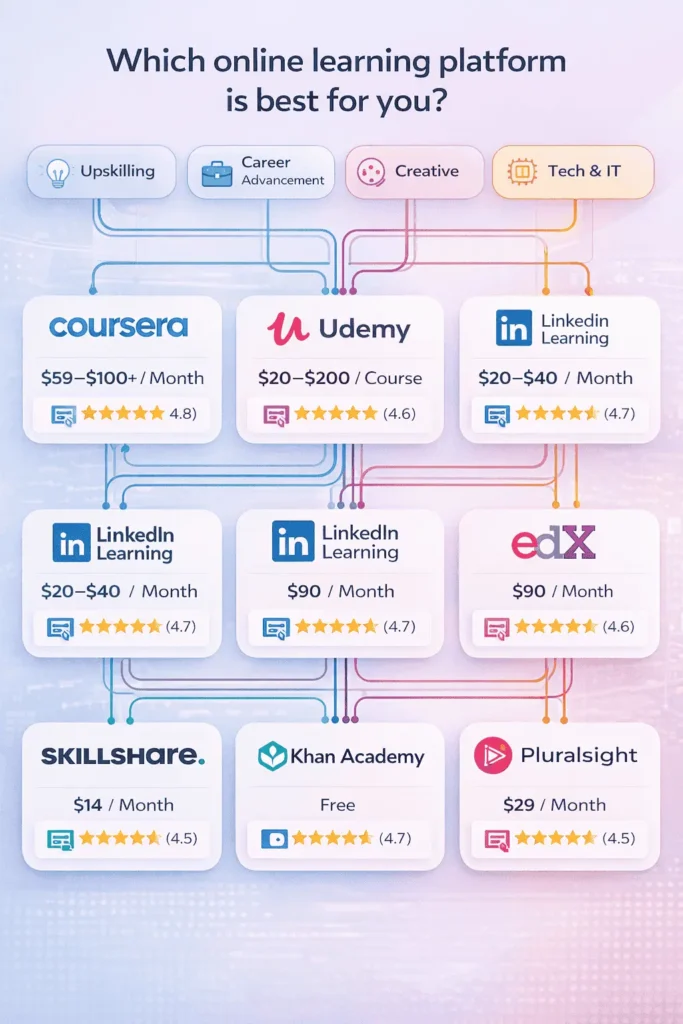
Coursera - University-Backed Credentials
Overview: Coursera partners with 200+ universities (Stanford, Yale, MIT) and companies (Google, IBM, Microsoft) to offer university-level courses, specializations, professional certificates, and even full degrees.
Best For: Professionals seeking recognized credentials, career changers needing credible certificates, anyone wanting university-level rigor
Pricing:
- Individual courses: $29-$99
- Guided projects: Starting at $10
- Specializations: $49/month
- Coursera Plus subscription: $59/month or $399/year (access to 7,000+ courses)
- Professional certificates: $39-$79/month
- Full degrees: $9,000-$25,000
Certification: University-backed certificates and degrees accepted by employers globally. Financial aid available for qualified learners.
Pros:
- Highest credibility with employer-recognized credentials
- 18x more free courses than Udemy (can audit most courses free)
- Structured learning paths from guided projects to degrees
- Accreditation from American Council on Education
- Excellent for resume-building and academic advancement
Cons:
- Higher price point than marketplace platforms
- Stricter deadlines in some courses
- Smaller course catalog (10,000+) compared to marketplaces
- More time commitment required
Notable Update: Coursera announced a merger with Udemy in December 2025, combining to create a $1.5 billion entity with complementary strengths—expect platform integration and expanded offerings in 2026.
Udemy - Vast Marketplace for Practical Skills
Overview: With 200,000+ courses taught by individual instructors, Udemy offers the broadest selection of on-demand learning across virtually every topic imaginable.
Best For: Self-starters wanting specific practical skills, professionals seeking affordable skill-building, hobby explorers, anyone who values variety
Pricing:
- Individual courses: $12.99-$199.99 (frequent sales drop prices to $10-$20)
- Personal Plan subscription: $16.58-$20/month for 10,500+ curated courses
- Business plan for teams: Custom pricing
- 30-day money-back guarantee
Certification: Certificates of completion (not accredited)
Pros:
- Largest course catalog globally (250,000+ courses vs Coursera's 10,000+)
- Extremely affordable, especially during sales
- Lifetime access to purchased courses
- Self-paced with no deadlines
- Courses on niche topics unavailable elsewhere
Cons:
- Variable quality (instructors not vetted like university partners)
- Certificates lack academic or professional accreditation
- Less structured than university-backed platforms
- Customer service issues reported in reviews
LinkedIn Learning - Career-Focused Professional Development
Overview: Integrated with LinkedIn profiles, this platform offers 17,000+ expert-led courses in business, technology, and creative fields with certificates that display directly on your professional profile.
Best For: Career professionals, job seekers wanting resume credentials, LinkedIn users, anyone focused on workplace skills
Pricing:
- Monthly subscription: $39.99/month
- Annual subscription: $239.88/year ($19.99/month)
- Often included free with LinkedIn Premium
- Free 1-month trial
Certification: Professional certificates that integrate with LinkedIn profiles (visible to recruiters)
Pros:
- Certificates display where recruiters search (your LinkedIn profile)
- Personalized recommendations based on career goals
- High-quality, professionally produced content
- Focus on immediately applicable workplace skills
- Often included with LinkedIn Premium
Cons:
- Higher cost than Skillshare or Udemy
- More lecture-style, less hands-on than some platforms
- Content focused on professional skills, limited hobby/creative courses
- No longer sells individual courses (subscription only)
edX - Academic Excellence and Advanced Degrees
Overview: Founded by Harvard and MIT, edX offers 4,600+ courses from 260+ partners including top universities, Google, IBM, Microsoft, and the World Bank.
Best For: Academic learners, degree seekers, anyone wanting free high-quality education with optional paid certificates
Pricing:
- Most courses can be audited free
- Verified certificates: Starting at $50
- Professional certificates: Varies by program
- MicroMasters: $600-$1,500
- Full master's degrees: Similar to Coursera
- Annual subscription: $349/year
Certification: University-issued verified certificates, MicroMasters credentials (can count toward full degrees), complete master's degrees
Pros:
- Founded by Harvard/MIT with elite university partnerships
- Majority of content accessible free (audit mode)
- Strong focus on academic rigor and advanced topics
- MicroMasters can stack toward full degrees
- Excellent for science, engineering, computer science
Cons:
- Fewer courses than Coursera or Udemy
- Interface less polished than competitors
- More academically rigorous (steeper learning curve)
- Certificates expensive relative to course length
Skillshare - Creative Skills and Community Learning
Overview: A subscription-based platform focused on creative skills—design, arts, photography, writing, entrepreneurship—with project-based learning and community engagement.
Best For: Creative professionals, hobbyists, entrepreneurs, anyone learning design/art/writing
Pricing:
- Monthly: $14/month
- Annual: $168/year
- Free 1-month trial
Certification: Certificates of completion (not accredited)
Pros:
- Extremely affordable unlimited access
- Strong community with peer feedback
- Project-based learning (learning by doing)
- Shorter, digestible courses (easier to complete)
- Focus on creativity over corporate skills
Cons:
- Limited technical/business content compared to LinkedIn Learning
- Certificates lack professional weight
- More hobbyist-oriented than career-focused
- Quality varies among instructors
Khan Academy - Free Foundational Education
Overview: Non-profit offering completely free education from K-12 through early college, focusing on math, science, humanities, and test prep.
Best For: Students, parents homeschooling, anyone needing foundational knowledge, test preparation (SAT, MCAT)
Pricing:
- Completely free (donation-supported)
Certification: None (focused on learning, not credentials)
Pros:
- Entirely free with no subscriptions
- Excellent for foundational knowledge
- Personalized learning dashboards
- Outstanding for K-12 students
- Test prep resources included
Cons:
- No certificates or credentials
- Limited advanced/professional content
- Focused on academic subjects, not career skills
- Not designed for adult professional development
MasterClass - Inspiration from World-Class Experts
Overview: Premium platform where celebrities and industry icons (Gordon Ramsay, Martin Scorsese, Serena Williams, Neil deGaiman) teach their crafts through cinematically produced video lessons.
Pricing:
- Standard: $10/month (1 device)
- Plus: $15/month (2 devices, offline downloads)
- Premium: $20/month (6 devices, offline downloads)
- Annual subscriptions range $120-$240
Certification: None
Pros:
- Learn from the absolute best in every field
- Cinematic production quality (like Netflix documentaries)
- Inspirational and motivational
- Unique access to world-class minds
- 30-day guided Sessions with assignments
Cons:
- No certificates or credentials
- More inspirational than technical/practical
- Higher cost than most platforms
- Limited hands-on skill development
- Not focused on career credentials
Best For: Lifelong learners valuing wisdom and inspiration, creative professionals seeking mindset shifts, anyone who learns best from stories and perspectives rather than step-by-step tutorials
Pluralsight - Technical and IT Mastery
Overview: Specialized platform for technology professionals offering structured learning paths in software development, IT operations, data, security, and cloud computing.
Pricing:
- Standard: $29/month or $299/year
- Premium: $45/month or $449/year (includes hands-on labs, assessments)
- Enterprise: Custom pricing for teams
Certification: Skill assessments and certificates (recognized in tech industry)
Pros:
- Deep technical content for developers and IT pros
- Hands-on labs and interactive environments
- Skill assessments measure actual competency
- Learning paths designed for career progression
- Highly respected in tech industry
Cons:
- Narrow focus (only tech/IT)
- Higher price than general platforms
- Steep learning curve for beginners
- Not suitable for non-technical learners
Best For: Software developers, IT professionals, data scientists, cybersecurity specialists, cloud engineers
Platform Comparison Table
| Platform | Monthly Cost | Best For | Accredited | Course Count | Free Options |
|---|---|---|---|---|---|
| Coursera | $59 | Career credentials | Yes (University) | 10,000+ | Audit most courses |
| Udemy | $16-20 | Practical skills | No | 250,000+ | Some free courses |
| LinkedIn Learning | $39.99 | Professional development | Recognized | 17,000+ | 1-month trial |
| edX | Free-$349/yr | Academic learning | Yes (University) | 4,600+ | Audit majority |
| Skillshare | $14 | Creative skills | No | Thousands | 1-month trial |
| Khan Academy | Free | Foundational education | No | Thousands | Everything |
| MasterClass | $10-20 | Inspiration | No | 180+ | None |
| Pluralsight | $29+ | Tech/IT skills | Industry-recognized | 7,000+ | Limited trial |
Choosing the Right Course
Selecting the perfect course requires more strategy than simply browsing trending topics. Here's how to ensure your investment—of time and money—pays off.
Identify Your Learning Goals
Before browsing catalogs, answer these questions honestly:
Career advancement: Do you need a specific skill for a current job, a promotion, or a career change? Prioritize practical, immediately applicable courses with recognized credentials.
Academic exploration: Are you satisfying curiosity or exploring new fields? Free audited courses on Coursera or edX let you experiment without financial commitment.
Skill building: Do you need proficiency in a tool (Excel, Python, Photoshop) or conceptual understanding? Hands-on, project-based courses deliver better results than lecture-heavy options.
Credential collection: Are you building a resume or portfolio? Focus on platforms offering employer-recognized certificates (Coursera, edX, LinkedIn Learning).
Evaluate Course Quality Indicators
Not all courses deliver equal value. Screen for quality using these criteria:
Instructor credentials: Look for industry experience, teaching background, or academic credentials. University-backed courses (Coursera, edX) vet instructors rigorously. Marketplace platforms (Udemy) require more scrutiny—check instructor profiles thoroughly.
Student reviews and ratings: Read recent reviews (last 6-12 months). Look for specific feedback about content quality, difficulty level, and practical applicability. Beware of courses with suspiciously perfect 5.0 ratings or very few reviews.
Course syllabus completeness: Quality courses provide detailed week-by-week outlines, learning objectives, and prerequisite requirements. Vague descriptions suggest poor planning.
Update frequency: Technology and business practices evolve rapidly. Check when the course was last updated—content more than 2-3 years old in tech fields is often obsolete.
Completion rate and outcomes: Some platforms share completion data. Courses with 60%+ completion rates are well-designed and engaging.
Consider Time Commitment Realistically
Total course length: Most online courses range from 4-12 hours for short courses to 3-6 months for specializations. Be honest about available time. Starting a 50-hour course when you have 2 hours weekly sets you up for failure.
Weekly expectations: Calculate realistic weekly commitment. If a course suggests 5-10 hours weekly and you consistently have only 3 hours, choose a shorter course or extend your timeline.
Deadlines vs. self-paced: Coursera and edX often have deadlines that create accountability but reduce flexibility. Udemy and Skillshare offer complete flexibility but require strong self-discipline.
Microlearning options: Platforms like LinkedIn Learning and Skillshare offer shorter courses (1-3 hours) perfect for busy schedules. You can complete entire courses during a weekend or spread them across lunch breaks.
Budget Considerations
Free course limitations: Free courses on Coursera and edX provide full content but withhold certificates. If you need credentials, factor certificate costs ($50-$99 typically) into budgets.
Subscription vs. per-course: Calculate cost-effectiveness. If taking multiple courses, subscriptions (Skillshare at $14/month, Coursera Plus at $59/month) offer better value than individual purchases. For single courses, Udemy's one-time payment wins.
Sales and promotions: Udemy runs frequent sales dropping $199 courses to $12-$20. Coursera offers 50% discounts periodically. Sign up for newsletters to catch deals.
Financial aid: Coursera and edX provide generous financial aid—many users receive 90%+ discounts by submitting aid applications. Don't let price deter you from university-backed courses.
Employer reimbursement: Many companies reimburse course costs. Check HR policies before paying out-of-pocket—you might get free learning.
Matching Platform to Goal
- Need recognized credential for resume: Coursera, edX, LinkedIn Learning
- Want specific technical skill quickly: Udemy, Pluralsight
- Exploring creative hobby: Skillshare, MasterClass
- Building foundational knowledge: Khan Academy, edX (audited)
- Limited budget: Khan Academy (free), Skillshare ($14/month), Udemy sales
- Career pivot requiring depth: Coursera or edX professional certificates/degrees
Success Strategies for Online Learning
Knowing how to learn online matters as much as choosing the right course. Here's how to maximize completion and retention.
Creating an Effective Study Schedule
Block dedicated time: Treat online learning like an appointment. Schedule specific days and times for coursework, add them to your calendar, and protect that time as you would a work meeting.
Optimal learning windows: Identify when you're most alert and focused. Morning people should study before work. Night owls learn better after 8 PM. Match difficult material to peak concentration periods.
Consistency beats marathons: Study 30 minutes daily outperforms 3.5-hour Sunday marathons. Regular engagement improves retention and builds habits that sustain completion.
Weekly reviews: Dedicate 15 minutes weekly to review notes and progress. This spaced repetition strengthens memory and identifies gaps before moving forward.
Buffer for life: Life happens. Build buffer time into schedules. If a course estimates 8 weeks at 5 hours weekly, plan 10 weeks at 4 hours. The flexibility prevents abandonment when unexpected demands arise.
Active Learning Techniques
Take handwritten notes: Research shows handwriting improves retention compared to typing. Summarize key concepts in your own words rather than transcribing verbatim.
Practice immediately: Apply new knowledge within 24 hours. Learned a Python concept? Write code using it. Studied marketing strategy? Analyze a real campaign. Immediate application transforms theory into understanding.
Teach others: Explaining concepts to friends, family, or online communities forces you to clarify thinking and reveals gaps in understanding.
Create projects: Go beyond course assignments. Build portfolio projects demonstrating mastery. These artifacts prove competency to employers and reinforce learning.
Engage discussions: Most platforms include forums or communities. Ask questions, answer peers' questions, and participate in discussions. Social learning increases engagement and completion rates to 85%.
Note-Taking Methods That Work
Cornell Method: Divide pages into three sections—notes, cues, and summary. During lectures, take notes in the main section. After, write questions/cues in the left margin and a brief summary at bottom. This structure facilitates review.
Mind mapping: Create visual diagrams connecting concepts. Particularly effective for courses covering interconnected ideas (business strategy, programming languages, historical events).
Digital organization: Use note-taking apps (Notion, Evernote, OneNote) to organize by course and topic. Digital notes are searchable, shareable, and accessible across devices.
Screenshot key slides: Capture important diagrams, formulas, or frameworks. Annotate screenshots with personal observations and examples.
Staying Motivated Through Completion
Start with quick wins: Begin courses with shorter, easier sections to build momentum and confidence before tackling challenging material.
Celebrate milestones: Reward yourself for completing modules, not just entire courses. Small celebrations maintain motivation through long programs.
Visualize progress: Many platforms show completion percentages. For those that don't, create visual trackers (progress bars, checklists) showing advancement.
Connect to goals: Remind yourself regularly why you're taking the course. Print goals and post them where you study. Emotional connection to outcomes sustains effort through difficult sections.
Join study groups: Find accountability partners taking the same course. Schedule regular check-ins, discuss concepts, and support each other through challenges. Platforms like Reddit, Discord, and Facebook host course-specific communities.
Break from perfectionism: Aim for completion, not perfection. Understanding 80% of material and finishing beats understanding 95% and abandoning halfway. You can revisit material later.
Building Accountability
Public commitment: Tell friends, family, or social media about your learning goals. Public commitment increases follow-through.
Study partners: Find someone taking the same course or learning similar skills. Schedule weekly video calls discussing progress and concepts.
Progress sharing: Post weekly updates on LinkedIn, Twitter, or Instagram. Social accountability and encouragement from networks boost persistence.
Financial stakes: Paid courses create sunk-cost motivation. You're more likely to complete a $50 course than a free one because you've invested money.
Track metrics: Log study hours, modules completed, and skills acquired. Seeing accumulating data provides tangible evidence of progress.

Free vs Paid Courses: Understanding the Value
The abundance of free educational content raises an important question: when should you invest in paid courses, and when do free resources suffice?
Value Comparison
Free courses excel at:
- Exploring new subjects before committing
- Building foundational knowledge
- Learning for personal enrichment without career implications
- Accessing content from elite institutions (MIT, Harvard via edX)
- Budget-constrained learning
Paid courses deliver:
- Recognized certificates employers respect
- Structured, curated learning paths
- Higher production quality and updated content
- Direct instructor support and feedback
- Access to hands-on labs, projects, and assessments
- Community features and peer learning
- No ads or upselling distractions
When to Invest in Paid Courses
Career advancement needs: If a course directly impacts promotions, job applications, or career changes, the cost becomes an investment with measurable ROI. A $500 professional certificate that enables a $10,000 salary increase pays for itself quickly.
Accountability required: Free courses report 5-15% completion rates. Paid courses see 15-40% completion, and courses with coaching support achieve 70%+. The financial commitment and additional support structures justify costs if you struggle with self-motivation.
Credential collection: Employers rarely accept "I watched free YouTube videos" as qualification. Official certificates from recognized platforms carry weight. If credentials matter, free courses don't serve your purpose.
Comprehensive learning paths: Free resources often provide fragmented knowledge. Paid specializations and professional certificates offer structured progressions from beginner to advanced, eliminating guesswork about what to learn next.
Current, maintained content: Free content often becomes outdated. Paid platforms continuously update courses as industries evolve, ensuring you learn current best practices rather than obsolete techniques.
Best Free Resources
Khan Academy: K-12 through early college subjects, completely free, excellent for foundational knowledge
Coursera (audited courses): Full access to lectures and materials from top universities, just without certificates
edX (audited courses): Similar to Coursera—comprehensive content from elite institutions available free
YouTube educational channels: Channels like CrashCourse, Khan Academy, MIT OpenCourseWare, and thousands of subject-matter experts provide high-quality free content
Google Digital Garage: Free digital marketing courses with certification
HubSpot Academy: Free marketing, sales, and customer service courses with certificates
freeCodeCamp: Comprehensive free coding bootcamp with certificates
Financial Aid Options
Don't let cost prevent learning. Many platforms offer substantial financial assistance:
Coursera Financial Aid: Up to 100% tuition assistance for individual courses, specializations, and professional certificates. Application takes 15 minutes, decisions within 2 weeks. Approval rates are high—simply demonstrate financial need and explain how the course advances your goals.
edX Financial Aid: Similar to Coursera, offers significant discounts based on need. Many learners receive 90% off.
Employer reimbursement: Check HR policies—many companies reimburse course costs, especially for job-relevant skills. Even small companies often support employee development.
Library access: Many public libraries offer free access to LinkedIn Learning, Coursera, and other platforms. Check with your local library.
Student discounts: Currently enrolled students often receive discounts or free access to platforms like GitHub (which includes GitHub Copilot) and various learning platforms.
The Value of Certifications
Perhaps no question generates more debate among online learners than certification value. Do employers care? Are they worth paying for? The answer is nuanced and context-dependent.
Industry-Recognized Certifications
Not all certificates carry equal weight. Tiers exist:
Tier 1 - University-backed credentials: Coursera and edX certificates from recognized universities (Stanford, MIT, Yale) and industry leaders (Google, IBM, Microsoft) carry substantial weight. Professional certificates in Data Science, Project Management, or Software Development demonstrate serious commitment and validated competency.
Tier 2 - Industry-specific certifications: Platform-agnostic certifications like AWS, Google Cloud, Microsoft Azure, CompTIA, and Cisco credentials prove technical proficiency and are often required for tech roles.
Tier 3 - Platform-completion certificates: LinkedIn Learning, Skillshare, and Udemy certificates confirm course completion but lack third-party validation. They demonstrate initiative and continuous learning but don't guarantee competency.
Tier 4 - No credential value: Free platform certificates from unknown instructors carry minimal professional value. Their worth lies in personal learning, not resume building.
Resume Impact
LinkedIn profiles: Certificates on LinkedIn increase profile views. Recruiters actively search for specific certifications—Google IT Support, IBM Data Science, AWS Solutions Architect. Having these visible credentials puts you in talent searches you'd otherwise miss.
Resume differentiation: In competitive job markets, certificates demonstrate proactive skill development. Two candidates with similar backgrounds compete—the one showing continuous learning through relevant certificates often wins.
Skills verification: Certificates provide shorthand for competency. Rather than claiming "I know Python," you present "Python for Everybody Specialization (University of Michigan via Coursera)" with verification links.
Portfolio complement: Certificates pair powerfully with portfolios. Your certificate proves you completed training; your portfolio proves you can apply that training to real projects.
Employer Perspectives
Reality check: perspectives vary dramatically by industry, company size, and role.
Tech industry: Technical skills matter more than credentials. A strong GitHub portfolio trumps certificates. However, certificates from Google, AWS, or Microsoft often serve as minimum qualifications for interviews.
Corporate environments: Larger companies value credentials during initial resume screening. HR systems may filter candidates by certifications. Once you're in the interview, demonstrated competency matters more, but certificates get you through the door.
Creative fields: Portfolios dominate. Certificates play supporting roles, showing you understand principles underlying your work.
Career changers: Certificates provide crucial credibility when pivoting industries. Without traditional credentials or experience, professional certificates from recognized institutions validate your commitment and basic competency in the new field.
The consensus: Certificates alone don't land jobs, but they open doors. Combined with practical experience, portfolios, and strong interviews, they strengthen candidacies. Think of certificates as table stakes in competitive markets—necessary but insufficient on their own.
Success Stories: Real Career Transformations
Online learning's true value reveals itself in individual success stories across diverse backgrounds and goals.
From Teacher to Tech Professional
Sarah M., 34, taught high school English for eight years before discovering coding through freeCodeCamp's free courses. After completing the program, she enrolled in Coursera's Google IT Support Professional Certificate ($49/month for 6 months). The credential helped her land an entry-level help desk role. Within two years, she transitioned to software development after completing additional Udemy courses in JavaScript and React. Current salary: $85,000—nearly double her teaching income—with fully remote flexibility.
Key success factors: Started with free resources to confirm interest, invested in recognized certificate for credibility, built portfolio projects demonstrating skills, networked in online communities.
Marketing Executive via LinkedIn Learning
James T., 42, worked in retail management for 15 years. Sensing limited growth, he invested in LinkedIn Learning's annual subscription ($240/year) and completed every marketing course available—digital marketing, SEO, content strategy, analytics. He updated his LinkedIn profile with certificates after each course completion. Recruiters noticed. After 8 months of focused learning and networking, James secured a digital marketing manager role at a tech startup. The $240 investment yielded a $28,000 salary increase.
Key success factors: Systematic learning approach, leveraged LinkedIn integration for visibility, applied learning through side projects for local businesses, demonstrated continuous improvement.
Designer Building Freelance Business
Priya K., 27, graduated with a generic business degree but passion for graphic design. She subscribed to Skillshare ($168/year) and completed 30+ design courses over 18 months. She posted her course projects on Instagram and Behance, gradually attracting clients. Within two years, Priya built a thriving freelance business earning $6,000+ monthly. She never attended design school or earned a formal design degree—just consistent online learning and relentless practice.
Key success factors: Project-based learning (Skillshare's model), public portfolio building, networking in design communities, treating learning as business investment.
Data Scientist Career Pivot
Marcus R., 29, worked in business operations with a bachelor's in economics. Intrigued by data science, he enrolled in Coursera's IBM Data Science Professional Certificate ($49/month for 10 months). The comprehensive program covered Python, SQL, machine learning, and data visualization. Marcus built portfolio projects analyzing public datasets and published findings on GitHub and Medium. The combination of certificate, portfolio, and demonstrated passion helped him land a junior data scientist role despite lacking a STEM degree or previous data experience.
Key success factors: Comprehensive, structured learning path, portfolio demonstrating applied skills, active community participation, willingness to start at junior level.
Essential Tools & Resources
Successful online learning extends beyond just course platforms. These tools amplify effectiveness.
Productivity Apps
Notion: All-in-one workspace for notes, task management, and course organization. Create databases tracking courses, deadlines, and progress.
Todoist/Microsoft To Do: Simple task managers for scheduling study sessions and tracking course milestones.
Forest/Freedom: Focus apps that block distractions during study sessions. Forest gamifies focus time; Freedom blocks specific websites and apps.
RescueTime: Automatic time tracking revealing how you actually spend time online, helping identify productivity drains.
Study Tools
Anki: Spaced repetition flashcard app scientifically proven to improve retention. Particularly powerful for memorizing facts, vocabulary, formulas.
Notion/Obsidian: Note-taking apps supporting linked notes and knowledge graphs. Build personal wikis connecting concepts across courses.
(Loom/OBS): Record yourself explaining concepts—teaching solidifies understanding.
Grammarly: Writing assistant ensuring professional communication in discussion forums and assignments.
Community Forums
Reddit: Subreddits exist for virtually every subject and major course. r/learnprogramming, r/courseralearners, r/udemylearning provide peer support.
Discord servers: Many courses and subjects maintain active Discord communities for real-time chat and study groups.
Course-specific forums: Most platforms include discussion boards. Active participation increases engagement and completion rates.
LinkedIn groups: Professional development groups offer networking and course recommendations aligned with career goals.
Conclusion: Your Learning Journey Starts Now
The landscape of online learning 2025 offers unprecedented opportunity. The platforms are mature. The content is comprehensive. The credentials are recognized. The costs are accessible. The flexibility accommodates every lifestyle. The only remaining barrier is action.
You don't need to commit to a degree or expensive bootcamp. Start simple: choose one skill you want to develop, select a platform aligned with your goals, and enroll in a single course. Dedicate 30 minutes daily. Complete it. Celebrate. Then choose your next course.
Remember: the most successful online learners aren't necessarily the most intelligent or disciplined. They're simply the ones who start and persist through completion. They treat learning as an investment, not an expense. They focus on progress, not perfection. They apply what they learn immediately. They connect with communities. They track their growth.
The world's best education is now accessible from wherever you are, whenever you can learn. Whether you're advancing your career, pivoting industries, exploring passions, or satisfying curiosity—the resources exist to support your goals.
At Findsfy, we're committed to helping you navigate your learning journey with guides, platform comparisons, course reviews, and success strategies. Subscribe for regular updates as platforms evolve and new opportunities emerge.
The question isn't whether online learning works—millions of success stories prove it does. The question is: when will you start writing yours?
Your education revolution begins today. Choose your platform. Enroll in your first course. Take that first lesson. The future you envision starts with the skills you build now.
Frequently Asked Questions
Are online courses worth it?
Yes—81% of students report improved grades from online learning, and courses cost 50-80% less than traditional education while delivering comparable outcomes. Choose accredited platforms for career credentials.
How long does it take to complete an online course?
Most short courses require 4-12 hours total, specializations need 3-6 months, and professional certificates take 6-12 months. Completion time depends on your weekly commitment and course structure.
Do employers recognize online certificates?
Employers increasingly recognize certificates from Coursera, edX, and LinkedIn Learning, especially when paired with portfolios demonstrating applied skills. University-backed credentials carry the most weight.
What's the best platform for beginners?
Khan Academy for foundational education (free), Skillshare for creative skills ($14/month), or Udemy for practical skills ($10-20 per course). Start with lower-commitment options before investing heavily.
How do I stay motivated to finish courses?
Set specific goals, create fixed study schedules, join accountability groups, celebrate milestones, apply learning immediately, and choose courses aligned with genuine interests or career needs.